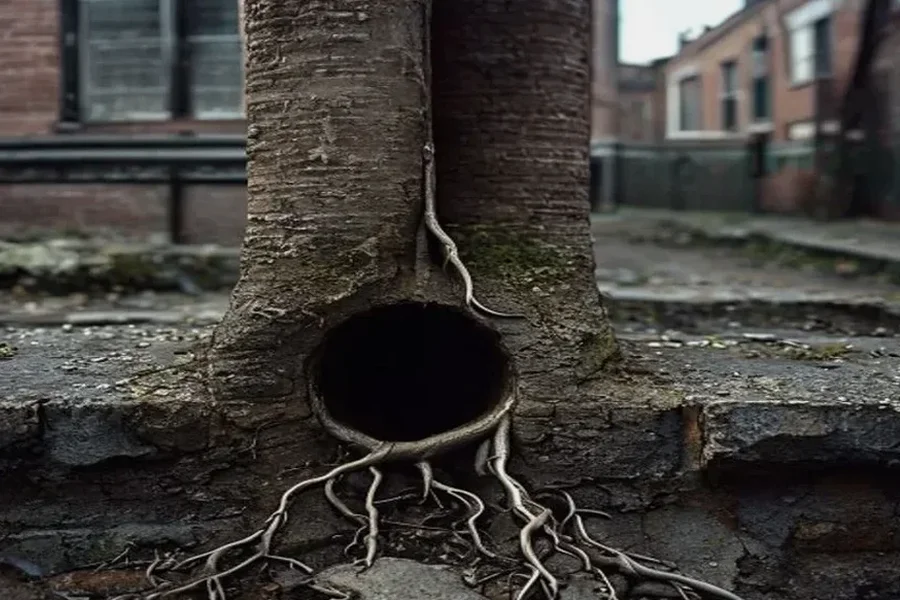
Mechanical cutting
Drum machine + cutting head sized to the historic lateral diameter (4-inch is the Lockerbie / Cottage Home standard; verify with camera first). Cuts the visible root mass back to the pipe wall along the affected run.
Indy Drain Pros — Licensed in Indiana · Bonded & Insured · Satisfaction Guaranteed · (317) 608-3777 Need more context on this neighborhood? See our full Downtown service area for the full coverage map.
Most downtown root calls don't come from the Mile Square high-rises — Penrose, Maxwell, Block 20, Cosmopolitan all sit on engineered modern sewer connections with no canopy-exposed lateral. The actual downtown root work is concentrated in the residential historic pockets: Lockerbie Square (1860s-1880s homes around the oldest preserved cobblestone streets in the city), Cottage Home on the eastern edge of downtown, the residential side streets around the Wholesale District conversions, and the blocks adjacent to Old Northside. These homes carry 1860s-1910s vitrified clay tile laterals under some of the oldest mature canopy in central Indianapolis — textbook root-intrusion territory. We cut, hydro jet the residue, then apply foaming herbicide for a 2-3 year cleared interval. 15-30 minute dispatch — the fastest in our service area. Browse our full service catalog or our Downtown service area. Standard Root Removal Downtown Indianapolis dispatch, 30-day clog-back guarantee.
Lockerbie Square. One of the oldest preserved residential districts in Indianapolis — cobblestone streets, 1860s-1880s homes, protected exterior treatment, and some of the oldest residential sewer laterals in the entire metro. Vitrified clay tile bell-and-spigot pipe was installed when public sewer first reached the district. Mature street trees — silver maple, oak, sycamore — have grown above those laterals for over a century. Root intrusion in Lockerbie laterals is the rule rather than the exception, and historic-district treatment means trenchless cut + jet + treatment is almost always the right answer over excavation.
Cottage Home and the eastern downtown edge. Cottage Home — the small neighborhood between downtown and Holy Cross — runs 1880s-1910s housing stock with original clay tile and a particularly dense mature canopy. The same materials and the same canopy stack into the same root-intrusion pattern. Cottage Home and the eastern downtown edge see steady root-work demand.
Old Northside-adjacent. The blocks bordering Old Northside (which is technically just outside the Mile Square but functions as downtown's historic residential extension) carry similar 1880s-1910s clay tile under similar canopy. Service approach is identical to Lockerbie — trenchless first, historic coordination in writing when surface work is required.
Wholesale District residential conversions and historic side streets. The 1900s brick warehouses converted to lofts and residential units sit on the original municipal sewer connections — root work in the conversions themselves is rare because the units are mostly 2nd floor and above. But the ground-level commercial spaces with adjacent courtyard or alley trees, and the small residential side streets surrounding the Wholesale District proper, do see clay-tile root intrusion. We coordinate access with the building management or unit owner before dispatch.
Modern Mile Square high-rises are different. Penrose, Maxwell, Block 20, Cosmopolitan, and the new towers along Meridian and Capitol are on modern PVC and ductile-iron building connections with no street-level lateral exposed to canopy. Root work in these towers is unusual — when residents call for slow drains the actual cause is hair, grease, or stack-line congestion. Camera scope confirms quickly and the treatment differs.
Cabling alone gets the visible roots out. The fishing-line tips at the joint regrow inside a year. We do all three steps every visit.
Drum machine + cutting head sized to the historic lateral diameter (4-inch is the Lockerbie / Cottage Home standard; verify with camera first). Cuts the visible root mass back to the pipe wall along the affected run.
4,000 PSI water jet pushes the cut root residue downstream to the city main. Pipe walls clean of biofilm where roots were attached. Leaving residue gives new root tips a foothold and shortens the cleared interval.
Copper sulfate or dichlobenil foaming agent applied through the cleared line. Foam coats pipe interior and joint entry points. Kills root tips on contact, extends cleared interval to 2-3 years from 9-15 months.
Annual treatment works on a single intruding joint. It stops working when the same 50-100 foot section shows three or more intrusion points on camera, when you're calling twice a year, or when a backup has reached floor-drain or basement level. Cured-in-place pipe lining seals every joint along the affected span in one one-day installation — and in Lockerbie Square, Cottage Home, and the historic-district pockets, the trenchless surface impact preserves the streetscape that excavation would compromise. Downtown CIPP math typically tips at year 5-7 of annual treatment, and the historic-district coordination is far simpler with a lining job than with a trench.
Standard for a single intruding joint. Most cost-effective when the pipe is otherwise sound and you're managing intrusion year to year.
Resin liner cures inside the existing pipe and seals every joint along the affected span. Preserves Lockerbie's cobblestone streetscape and historic restoration requirements. Trenchless.
See our Downtown main sewer line repair page for full CIPP detail and Lockerbie / Old Northside historic-coordination scope.
130+ year clay tile under mature street trees. Annual treatment is the maintenance default.
Groundwater pressure pushes through loosened clay joints. Strong root indicator in historic-pocket homes.
Alley silver maple or honey locust behind the building can put roots into a shared lateral. Building access coordination first.
Probably not roots. Camera scope first — hair, grease, or stack congestion is the usual cause in Penrose/Maxwell/Block 20.
Same flat-rate everywhere — crews staged across the metro. Each area page covers the local pricing detail + access notes.
Lockerbie Square + Cottage Home + Wholesale District residential historic-pocket clay tile. Historic-district coordination. 15-30 minute dispatch.
Call (317) 608-3777Modern Mile Square high-rises almost never have root intrusion — they're built on engineered modern sewer connections with no street-level lateral exposed to canopy. Downtown root work is concentrated in Lockerbie Square, Cottage Home, Old Northside-adjacent, and the residential side streets surrounding the Wholesale District. Those homes have 1860s-1910s vitrified clay tile under mature street canopy.
Mechanical cutting head only is $400-$550. Combined with hydro jetting and foaming herbicide is $650-$950 — the upper end reflects historic-district coordination, alley-access work, and condo HOA scheduling where applicable. Flat-rate after camera scope.
Yes. Trenchless root work (cut + jet + treat) leaves no surface disruption — which is why it's the default in Lockerbie. Where excavation is unavoidable downstream of treatment failure, we coordinate restoration with the homeowner and historic-district approvals before any cut. Cottage Home and Old Northside-adjacent follow similar protocols.
15-30 minutes from our central staging — fastest in our service area. Lockerbie Square, Cottage Home, Wholesale District residential blocks, and Old Northside-adjacent are all within the inner dispatch radius. For declared sewer emergencies we target arrival inside 60 minutes regardless of traffic.
Most Lockerbie and Cottage Home laterals run through the rear yard to an alley-side connection. We coordinate access with the homeowner before dispatch — alley parking, equipment staging, and adjacent-property notification where the work footprint touches a neighbor's lot line. The trenchless approach keeps the alley access minimal.
Yes. Conversions in the Wholesale District typically have HOA contractor protocols and sometimes shared lateral arrangements with adjacent units. We work through building management or the unit owner on access, billing, and certificate-of-insurance requirements before scheduling the visit.
Yes. The foaming agents (copper sulfate or dichlobenil-based) are EPA-registered for in-pipe sewer use. They stay inside the lateral, attack root tips at the joint entry, and flush to the city main as part of normal sewer flow. They don't affect the trees above ground, the trunk roots, or any adjacent landscaping.
Yes. Footage of the affected lateral is recorded, shared after the cut, and kept on file. Useful for comparing pre- and post-treatment, for resale-pre-inspection documentation in Lockerbie homes, and for deciding the CIPP-versus-treatment timing in future years.
Camera-diagnosed first. Trenchless every visit. EPA-registered foaming herbicide. CIPP lining priced side-by-side when the math turns. Lockerbie / Cottage Home / Wholesale District historic-coordination handled.