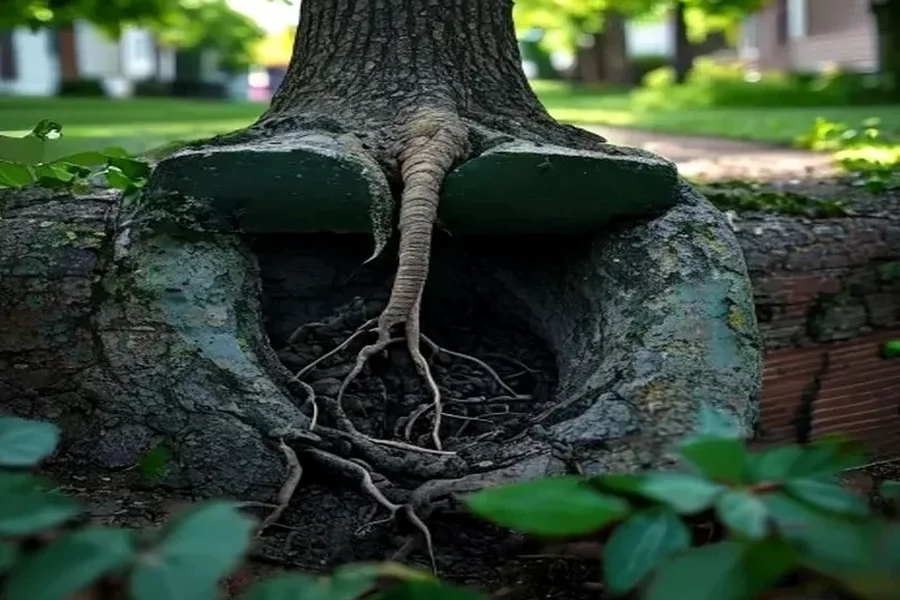
Mechanical cutting
Drum machine + cutting head sized to the lateral (4-inch standard for Old Town; verify with camera). Cuts root mass back to the pipe wall along the affected run. Camera confirms removal of the visible material before we move on.
Indy Drain Pros — Licensed in Indiana · Bonded & Insured · Satisfaction Guaranteed · (317) 608-3777 Need more context on this neighborhood? See our full Greenwood service area for the full coverage map.
Greenwood root work splits cleanly along housing era. Old Town Greenwood — the Main Street and Madison Avenue corridor and the blocks around the historic core — runs 1880s-1920s vitrified clay tile under canopy that's been thickening over the same 100+ years the laterals have been in service. Bell-and-spigot joints every 4 feet, mature silver maple and oak above, recurring root intrusion is the rule. Stones Crossing, Hickory Trail, Pine Glen, and the Center Grove growth corridor run modern PVC where root intrusion is unusual — when those homes call us for slow drains the camera usually shows something else. We cut, hydro jet the residue, then apply foaming herbicide to kill root tips on contact and extend the cleared interval to 2-3 years. Same Indianapolis flat-rate — no Johnson County surcharge. Browse our full service catalog or our Greenwood service area. Standard Root Removal Greenwood dispatch, 30-day clog-back guarantee.
Old Town Main Street and Madison Avenue. The original Greenwood settlement around Main Street, Madison Avenue, and the side streets between them carries 1880s-1920s housing on its original vitrified clay tile sewer laterals. Public sewer reached the historic core in those decades, and the standard residential lateral material was clay tile — a bell-and-spigot pipe that lasts a century if you leave it alone but joints loosen with ground settlement, frost cycles, and the steady mechanical pressure of mature tree roots probing for moisture. Once a joint develops a hairline gap, the fishing-line root tip enters, hits warm nutrient-rich water, and the whole root system follows.
The Old Town canopy is older than most of Indianapolis's residential trees. Greenwood's historic core has been continuously developed since the mid-1800s, which means the mature street trees lining Main, Madison, and the surrounding blocks predate most of the residential canopy further north in Marion County. Silver maple, oak, sycamore, and the occasional mulberry are all aggressive root systems with permanent moisture pressure on the clay laterals underneath. Cutting alone gets a few months; treatment extends the cleared interval to 2-3 years and works well as an annual maintenance approach while the canopy stays.
The Stones Crossing growth corridor is a different story. Greenwood's post-2000 expansion — Stones Crossing, Hickory Trail, Pine Glen, the County Line corridor, the Center Grove subdivisions — runs modern PVC laterals throughout. Solvent-welded joints don't create the entry points clay tile does. Root intrusion in these neighborhoods is unusual within the first 30 years. When growth-corridor homes call for slow drains, the actual cause is usually a builder-grade slope problem, a settlement belly where backfill compacted unevenly, kitchen grease accumulation, or a hair clog in a branch line. Camera scope confirms quickly and changes the recommended treatment.
Center Grove area. Center Grove is mostly newer subdivisions west of US-31 with the same PVC profile as Stones Crossing — rare root intrusion, common builder-grade or settlement issues. The exception is the older farmsteads and pre-2000 housing along the original Stones Crossing Road and the back county roads, which can carry clay tile or Orangeburg laterals under mature canopy and do see genuine root work.
The restaurant corridor. Old Town Main Street, the Greenwood Park Mall corridor, and the chain dining along the County Line / I-65 interchange all see grease-driven slow drains rather than root work. That work routes to our hydro jetting and grease trap protocols — different equipment, different scheduling.
Cabling alone gets a few months. The canopy isn't going anywhere. We do all three steps every visit so the cleared interval extends to 2-3 years.
Drum machine + cutting head sized to the lateral (4-inch standard for Old Town; verify with camera). Cuts root mass back to the pipe wall along the affected run. Camera confirms removal of the visible material before we move on.
4,000 PSI water jet pushes the cut root residue downstream to the city main. Pipe walls clean of biofilm where roots were attached. Leaving residue gives new root tips a foothold and shortens the cleared interval — so we always flush.
EPA-registered copper sulfate or dichlobenil foaming agent applied through the cleared line. Foam coats the pipe interior and the joint entry points. Kills root tips on contact at the joint, extends cleared interval to 2-3 years from 9-15 months.
Annual treatment works when a single Old Town joint is intruding mildly. It stops working when the same 50-100 foot section shows three or more intrusion points on camera, when you're calling twice a year, or when a backup has reached floor-drain or basement level. Cured-in-place pipe lining seals every joint along the affected span in one one-day installation — and the trenchless surface impact preserves the Old Town streetscape and the mature canopy that traditional excavation would compromise. Greenwood CIPP math typically tips somewhere between year 5 and year 8 of annual treatment.
Standard for a single intruding joint with sound pipe otherwise. Most cost-effective short-term while you're managing intrusion year to year.
Resin liner cures inside the existing pipe and seals every joint along the affected span. Roots can't find entry. Trenchless — preserves Old Town's mature canopy and streetscape.
See our Greenwood main sewer line repair page for full CIPP lining detail and Old Town historic-coordination scope.
100+ year clay tile under permanent canopy pressure. Annual treatment beats annual cabling alone.
Groundwater pressure through loosened clay joints. Strong root indicator in the Old Town pocket.
Vent disruption from a partial root obstruction in the lateral. Classic early sign before a full main-line backup.
Probably not roots — likely a settlement belly, slope issue, or grease. Camera scope first so the treatment matches.
Same flat-rate everywhere — crews staged across the metro. Each area page covers the local pricing detail + access notes.
Old Town Main + Madison Ave clay tile specialty. Stones Crossing camera-scope-first. Same Indianapolis flat-rate — no Johnson County surcharge.
Call (317) 608-3777Old Town Greenwood — Main Street and Madison Avenue — has 1880s-1920s homes with original vitrified clay tile laterals. The bell-and-spigot joint every 4 feet creates an entry point as joint compound deteriorates. Combined with mature canopy that's grown along the historic core for 100+ years, root intrusion is the dominant Old Town drain failure mode. Stones Crossing and the County Line growth corridor are different — modern PVC where roots are unusual.
Mechanical cutting head only is $400-$550. Combined with hydro jetting and foaming herbicide is $650-$900. Same flat-rate as central Indianapolis — no Johnson County travel surcharge. Camera scope first so the treatment matches the actual cause.
Rarely. The post-2000 Greenwood growth-corridor subdivisions run modern PVC where joints are solvent-welded. Root intrusion is unusual within the first 30 years. When growth-corridor homes call for slow drains, the actual cause is usually a builder-grade slope issue, kitchen grease, or a hair clog. Camera scope confirms quickly.
If the same lateral needs cutting twice a year, or camera scope shows three or more intrusion points along the affected span, or a backup has reached floor-drain or basement level. Annual treatment runs $650-$900 a year; CIPP is $4,500-$9,000 once with a 50-year service life. Past year 5-7 the lining math typically wins.
Yes. The foaming agents (copper sulfate or dichlobenil-based) are EPA-registered for in-pipe sewer use. They stay inside the lateral, attack root tips at the joint entry point, and flush to the city main as part of normal sewer flow. They don't affect the tree above ground or its trunk roots — only the fine fishing-line roots that have entered the pipe.
Dispatch is 50-70 minutes from our central staging via I-65 south or the Madison Avenue corridor. Same flat-rate as a Marion County call — no Johnson County travel surcharge. Old Town root calls are usually scheduled rather than emergency, but declared backups get same-day priority regardless of zip.
Yes. Footage of the affected lateral is recorded, shared after the visit, and kept on file. Useful for confirming the diagnosis, for resale-pre-inspection documentation in Old Town homes, and for deciding the CIPP-versus-treatment timing in future years.
Yes. For homes with confirmed recurring intrusion we schedule cut + jet + treatment on a 12 or 24 month rotation and price it as a maintenance plan rather than separate calls. We carry the camera-history file so you don't have to remember the dates or the affected section.
Camera-diagnosed first. Cutting head sized to your lateral. 4,000 PSI hydro jet flush. EPA-registered foaming herbicide. CIPP lining priced side-by-side when the math turns. Same Indianapolis flat-rate.