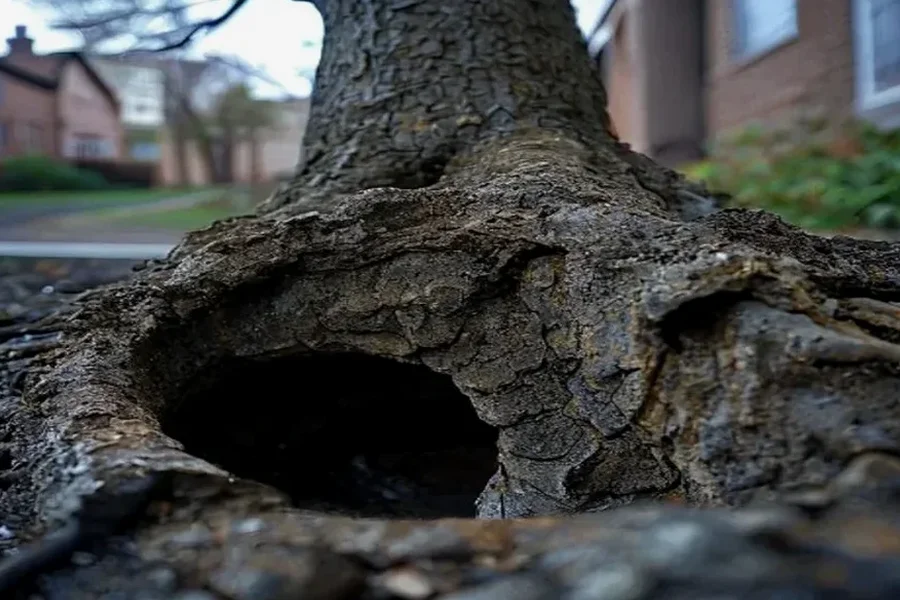
Mechanical cutting
Drum machine with cutting head sized to the lateral (4-inch standard for M-K pre-war homes). Cuts root mass back to the pipe wall along the affected run. Camera confirms removal before we move on.
Meridian-Kessler runs one of the heaviest root-intrusion profiles in north Indianapolis. The 1910-1940 Tudor, Colonial Revival, and Arts & Crafts homes along Meridian Street, Pennsylvania Street, Delaware Street, and the cross streets between 46th and 56th carry original vitrified clay tile sewer laterals. The century-old canopy — silver maple, oak, sycamore, occasional black walnut — has been deliberately preserved by the Meridian-Kessler Neighborhood Association for decades. Mature trees + 100-year clay bell-and-spigot joints = permanent root pressure on every lateral. We cut, hydro jet the residue, then apply foaming herbicide for a 2-3 year cleared interval. Careful work around hardwood floors, plaster walls, antique fixtures. Same Indianapolis flat-rate. Browse our full service catalog or our Meridian-Kessler service area. Standard Root Removal Meridian-Kessler dispatch, 30-day clog-back guarantee.
1910-1940 pre-war housing stock with original clay tile. The Meridian-Kessler streetscape was platted and built between 1910 and 1940 — Tudor Revival mansions along Meridian Street, Colonial Revival and Dutch Colonial along Pennsylvania and Delaware, Arts & Crafts bungalows on the cross streets. Public sewer reached the neighborhood as those homes were being built, and the standard residential lateral material was vitrified clay tile in 4-foot bell-and-spigot lengths. After a century-plus, joint compound has deteriorated at most joints across the M-K core. Need more context on this neighborhood? See our full Meridian Kessler service area for the full coverage map.
One of the most-preserved mature canopies in Indianapolis. Meridian Street's tree-lined boulevard character is the neighborhood's signature visual asset — and the Meridian-Kessler Neighborhood Association has actively defended that canopy for decades. Silver maple, oak, sycamore, ginkgo, and occasional black walnut line every block. The canopy isn't getting smaller; mature trees that fail are replaced. From a sewer perspective, that means root pressure on every lateral is permanent. No "wait for the tree to die" strategy applies in M-K.
Long lateral runs to the city main. M-K lot depths from Meridian Street to the alley average 150-200 feet, with the home typically set back 30-50 feet from the street. The lateral run from foundation to the main sewer line often reaches 100-130 feet. Longer laterals = more bell-and-spigot joints = more potential root entry points. The math compounds.
The premium-market consideration. M-K property values are among the highest in Marion County. Homeowners and buyers care about long-term lateral condition, treat camera scope as standard pre-purchase due diligence, and frequently opt for one-time CIPP lining over annual maintenance because the one-time cost is a smaller fraction of home value. We respect that — we present both options with honest numbers and let the homeowner choose. No upsell pressure on either side.
Standard cut + jet + foaming herbicide protocol. The canopy isn't going anywhere, so the treatment step is what stretches the cleared interval from months to years.
Drum machine with cutting head sized to the lateral (4-inch standard for M-K pre-war homes). Cuts root mass back to the pipe wall along the affected run. Camera confirms removal before we move on.
4,000 PSI water jet pushes cut root residue downstream to the city main. Pipe walls clean of biofilm. Leaving residue gives new root tips a foothold — so we always flush.
EPA-registered copper sulfate or dichlobenil agent applied through cleared line. Coats joint entry points, kills root tips on contact, extends cleared interval to 2-3 years from 10-15 months.
In most Indianapolis neighborhoods the CIPP math tips against annual treatment at year 5-7. In Meridian-Kessler it often tips at year 3-5. Three reasons. First — the canopy is denser than average, so root regrowth is faster and treatment interval is shorter. Second — long M-K lateral runs (100-130 ft) mean annual treatment costs land at the upper end ($800-$900 per visit) where shorter laterals run lower. Third — M-K home values often make the one-time CIPP cost a smaller fraction of home value than 8-10 years of annual treatment compounded. We're not pushing CIPP; we're being honest about when the math turns. Camera scope tells us where you are on that curve.
Standard for single-joint intrusion with sound clay tile. Right call when intrusion is mild and the math hasn't turned yet.
One-time fix seals every joint along the affected span. Trenchless preserves the M-K canopy. Often the right call past year 3-5 of annual treatment.
See our main sewer line repair page for full CIPP detail.
Canopy preserved by the neighborhood association = permanent root pressure. Annual treatment is the maintenance default.
Pre-purchase camera scope ($250, credited) tells you the true cost of ownership before contract.
Vent disruption from partial root obstruction in the lateral. Classic early sign before a main-line backup.
M-K math tips toward CIPP. Worth pricing one-time lining vs continuing the annual cycle.
Same flat-rate everywhere — crews staged across the metro. Each area page covers the local pricing detail + access notes.
1910-1940 Tudor / Colonial Revival / Arts & Crafts clay tile specialty. Preserved canopy. Careful work around hardwood + plaster + antique fixtures.
Call (317) 608-37771910-1940 Tudor, Colonial Revival, and Arts & Crafts homes along Meridian Street, Pennsylvania Street, Delaware Street, and cross streets between 46th and 56th run original vitrified clay tile laterals. The neighborhood's century-old canopy has been preserved by the Meridian-Kessler Neighborhood Association for decades. Mature trees + 100-year clay-tile bell-and-spigot joints = consistent root intrusion.
Mechanical cutting only is $400-$550. Combined with hydro jetting and foaming herbicide is $650-$900. M-K calls run the same flat-rate as central Indianapolis. Upper end reflects the longer 100-130 ft lateral runs typical of M-K lot depths.
Often yes — and we'll be honest about it on the scope. The M-K math typically favors CIPP earlier than other neighborhoods because (1) the canopy is older and root pressure is permanent, (2) homeowners care about preserving mature trees so trenchless wins, (3) higher property values make CIPP a smaller fraction of home value than annual treatment compounded. If scope shows 3+ intrusion points and the clay is structurally sound, we price both side-by-side.
No. The work happens outside the home (cleanout access) or at the basement floor cleanout. No equipment touches the interior finish work. Drop cloths under indoor work area. We protect 1920s tile bathrooms, original hardwood, plaster walls, and antique fixtures specifically because M-K homeowners care about them.
No. The foaming agents (copper sulfate or dichlobenil-based) are EPA-registered for in-pipe sewer use. They stay inside the lateral, attack root tips at the joint entry point, and flush to the city main as part of normal sewer flow. They don't affect the tree above ground, its trunk roots, or any adjacent landscaping. The M-K canopy is preserved.
Some M-K blocks have mature black walnut trees that produce juglone (a natural growth inhibitor in soil). Juglone doesn't affect sewer root intrusion — black walnut roots still find clay-tile joints just like silver maple or oak. From a root-removal perspective, the species doesn't change the protocol or the timing. Camera scope identifies intrusion regardless of which species is the source.
Yes. For confirmed recurring intrusion we schedule cut + jet + treatment on a 12-month rotation and price it as a maintenance plan rather than separate calls. We carry the camera-history file so you don't have to remember the dates. Most M-K maintenance accounts switch to CIPP within 4-6 years.
M-K is 30-45 minutes from central staging via Meridian Street or College Avenue — closer than Irvington, similar to Broad Ripple. Same flat-rate dispatch regardless. For declared emergencies (sewage backing up), we target arrival within 60 minutes.
Same flat-rate pricing, same drain-only specialists — different problem? Jump to the right page.
Camera-diagnosed first. We tell you honestly when the M-K math has tipped toward CIPP. EPA-registered foaming herbicide preserves the canopy. Careful work around hardwood, plaster, antique fixtures.