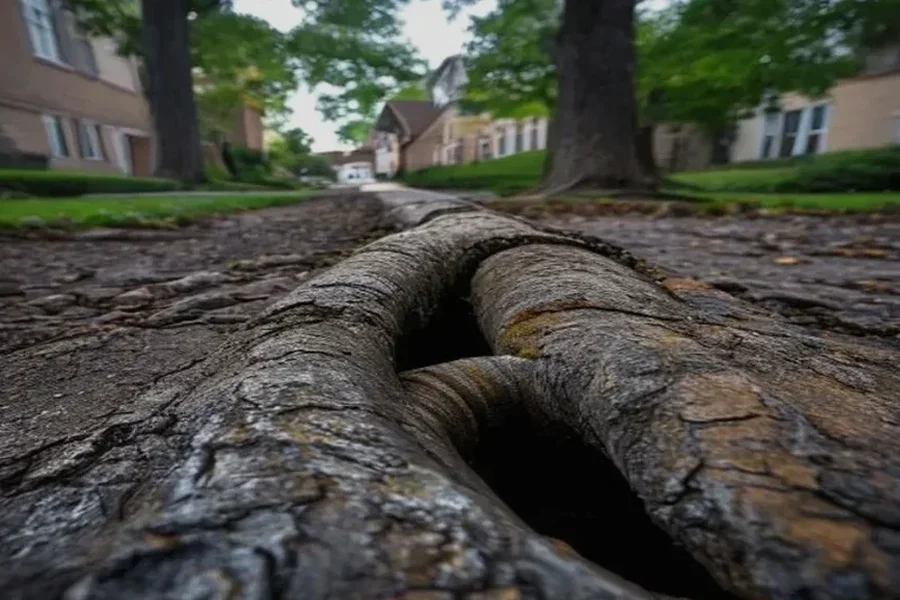
Courthouse-square vitrified clay tile is the heavy root zone. The blocks around the Hamilton County Courthouse — 8th Street, Conner Street, Logan Street, Cherry Street, and the original platted blocks — have homes from the 1860s-1880s with original sewer laterals laid when public sewer first reached the neighborhood. Vitrified clay tile in bell-and-spigot lengths every 4 feet was the standard material of the era and a meaningful share of those original laterals are still in service. The failure modes are predictable: tree-root intrusion at every joint, gradual joint offset as ground settles, occasional segment cracking from frost heave or impact. The mature canopy that has grown along the square for more than a century puts permanent root pressure on every clay joint underneath.
Old Town laterals run deeper than typical. Courthouse-square laterals frequently run 8-12 feet deep where modern subdivisions might be 4-6 feet — a function of when the public main was set and how the streets graded over the next century. Deeper laterals mean more jet line, more cable, slightly higher per-visit pricing on the upper end of our flat-rate range. But the trenchless cut + jet + treatment workflow handles depth transparently — the access pit stays shallow regardless of the lateral depth between joints.
West-of-37 ranch belt Orangeburg. The 1960s-1980s build-out west of SR-37 — the corridors near Noble Hawk Golf Links, the older subdivisions south of Pleasant Street, and the ranch belt toward the county line — frequently has original Orangeburg laterals. The tar-impregnated wood-fiber composite was the budget pipe material of the era. Root intrusion in Orangeburg is less common than in clay tile because the pipe wall is continuous rather than jointed, but Orangeburg fails differently: oval deformation and eventual collapse. Camera scope sorts which mode we're dealing with — if confirmed roots, the standard cut + jet + foam protocol applies; if deformation, we route to spot excavation or pipe bursting instead.
Hamilton Town Center, Wood Wind, Morse Reservoir PVC. The 2000s-2020s growth zone east of SR-37 runs modern PVC laterals throughout. Solvent-welded joints don't create the entry points clay tile does. Root intrusion in these neighborhoods is unusual within the first 30 years. When HTC or Wood Wind homes call for slow drains, the actual cause is usually a single offset, grease accumulation, or a hair clog. Camera scope confirms quickly.
Morse Reservoir-adjacent considerations. Morse-adjacent homes off Lakeside Drive and the Reservoir Hills area deal with high water tables that can mimic root symptoms — basement floor drain backups after heavy rain that turn out to be groundwater intrusion at floor-drain backflow rather than lateral root obstruction. Camera scope tells us which.