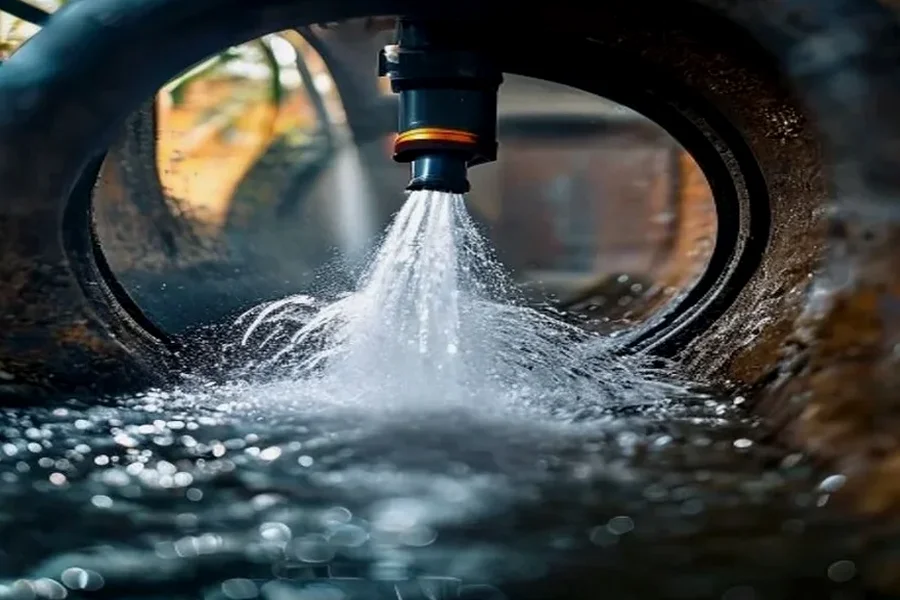
When cabling won't last, jetting will. Pressurized water removes grease, scale, sludge, and tree roots wall-to-wall — restoring the line to original inside diameter. Pre & post camera-scoped on every Indianapolis call. Flat-rate $350-$900. Part of our complete drain & sewer service lineup at Indy Drain Pros. See it next to standard drain cleaning. Every Hydro Jetting Indianapolis call gets a written quote before we start.
Hydro jetting cost in Indianapolis — what you'll pay in 2026
Every job is flat-rate, quoted in writing before a hose goes near your cleanout. No hourly billing, no overtime surcharges at 2 a.m., no surprises when the invoice arrives.
Line type
What's included
Flat-rate range
Residential branch line (kitchen, laundry, bath)
Pre-jet camera scope + jetting pass + downstream flush test
$350 – $750
Residential main sewer lateral
Root-cutting or degreasing nozzle + full-line jet + post-jet camera verification
$450 – $850
Commercial FOG (fats, oils, grease) line
Extended-dwell degreasing nozzle + flush to city main + IDEM-compliant documentation
$500 – $1,500
Camera scope add-on (if not bundled)
HD push-camera inspection, recorded video provided to customer
$125 – $295
Why prices vary
Line length, cleanout accessibility, severity of FOG accumulation, and whether a root-cutting rotating nozzle assembly is required all affect the final quote. Camera scope findings set the price — you see exactly what we see before approving any work.
When we won't jet
If pre-inspection reveals severely deteriorated Orangeburg pipe, pre-1950 vitrified clay with open joints, or cast iron with active fractures, we'll quote a repair instead of a jet — see main sewer line repair. High-pressure water jetting on a compromised Marion County sewer lateral creates more damage than it solves.
Equipment & physics
How a hydro jetter works — the physics behind 4,000 PSI
High-pressure water jetting is not a glorified garden hose. The engineering behind it is specific — and understanding it explains why a drum auger simply can't match the result on a grease-dominant or scale-heavy line.
A commercial hydro jetter consists of a displacement pump, a skid-mounted or trailer-mounted water tank, a PSI gauge and relief valve, and a high-pressure hose rated for the working load. The hose terminates in a rotating nozzle assembly designed specifically for sewer lateral work. That nozzle does two distinct things simultaneously:
Forward-cutting jets
Angled jets at the nozzle face bore through the grease plug, root mass, or sediment column ahead of the hose. The cutting action is what allows the nozzle to advance through a fully occluded pipe — something a drum auger achieves mechanically, but water jetting achieves without cable torque risk inside aging clay tile.
Rearward-thrust propulsion
Rearward-angled jets provide two functions: they propel the hose forward through the pipe (no need to physically push hundreds of feet of hose), and on the withdrawal pass they scour the full pipe wall circumference — removing the FOG accumulation, mineral scale, and biofilm coating that a snake leaves behind entirely.
At 4,000 PSI and a flow rate measured in gallons per minute (GPM), the kinetic energy delivered to the pipe wall is sufficient to strip calcium buildup, cut root fibers at the intrusion point, and flush the resulting debris downstream in a single continuous pass. Residential sewer laterals typically run at 3,000–4,000 PSI; commercial FOG lines serving restaurant row often require the full 4,000 PSI to emulsify and dislodge multi-year grease plug accumulations. The technician monitors the PSI gauge and adjusts the relief valve output based on what the pre-inspection camera revealed about pipe condition and material.
Pipe material matters to nozzle selection. Cast iron descaling uses an aggressive rotating nozzle that spins at high RPM to abrade calcium deposits back to bare metal. PVC and ABS lines use a gentler fan-spread nozzle that removes grease without scoring the smooth interior. HDPE and newer vitrified clay in good condition are jet-compatible; Orangeburg and clay with failed joints are not — water pressure accelerates joint separation on compromised pipe.
Snake or jet?
When hydro jetting is the right call — and when it isn't
We run both drum augers and water jetters on every truck. The pipe content and condition determine which tool we pull out. Here is the honest breakdown.
Choose the drum auger (snaking) Faster, lower cost
Mechanical cable is the right first call for isolated, non-recurring clogs where the pipe walls are otherwise clean. A snake punches through and restores flow in 45–90 minutes at lower cost.
Best for: single hair clogs, paper blockages, food debris, isolated toilet clogs
Choose high-pressure water jetting Full-diameter clearing
Jetting is the right tool when the clog keeps coming back, when grease is the dominant material, or when scale has reduced the pipe bore enough to guarantee a rapid re-clog after snaking.
Best for: FOG accumulation, calcium buildup on cast iron, root mass in clay tile, recurring same-line clogs
Pipe condition: sound walls confirmed by pre-inspection camera
Recurrence pattern: same drain clogs every 3–12 months
Typical cost: $350 – $850
Not appropriate for: Orangeburg pipe, severely deteriorated pre-1950 clay tile with open joints, cast iron with active transverse fractures — these need repair, not pressure
One rule we follow without exception: we scope first. A licensed technician will not deploy a water jetter on a Marion County sewer lateral without a camera pass that confirms the pipe wall is structurally sound. A blown joint in a clay tile lateral under a century-old Irvington bungalow costs far more to repair than a proper pre-inspection prevents.
Indianapolis-specific
What Indy Drain Pros jets — and what we find
Indianapolis drain problems are geographically specific. The material filling a sewer line in Broad Ripple is different from what we find in Meridian-Kessler or Irvington. The neighborhoods determine the clog.
Grease plugs — Mass Ave & Broad Ripple restaurant row
Commercial kitchen drain lines on Massachusetts Avenue and Broad Ripple Village accumulate FOG (fats, oils, grease) at a rate that overwhelms standard grease trap intervals. IDEM FOG regulations require these discharge lines to flow freely — a grease plug that backs up into a restaurant kitchen is both a health violation and an Indianapolis DPW concern. We jet commercial FOG lines at 4,000 PSI with an extended-dwell degreasing nozzle pass, then flush to the city main.
Mineral scale — Meridian-Kessler cast iron
Meridian-Kessler homes built between 1920 and 1960 run cast iron drain stacks that have been accumulating calcium and mineral scale for 60–100 years. Indianapolis water hardness accelerates scale deposition inside horizontal runs where flow velocity drops. A drum auger scores the scale surface but leaves the coating. Cast iron descaling requires a high-RPM rotating nozzle assembly at sustained pressure — the pipe wall scours back to bare metal, restoring the original inside diameter and the flow rate that came with it.
Pre-1950 clay tile sewer laterals in Irvington, Fountain Square, and the Fall Creek corridor leak at every joint — and tree roots follow moisture through those cracks. The root mass that fills the pipe interior looks like a dense fibrous plug. A spinning root-cutting nozzle assembly at 4,000 PSI shreds and flushes the root fiber mass. Post-jet camera scope confirms full-diameter clearing; foaming herbicide applied at the intrusion points retards regrowth. Without herbicide, the same root tip returns in 12–18 months. With it, 2–3 years is typical.
The process
The hydro jetting process — from cleanout to camera confirmation
Every Indianapolis hydro jetting call follows the same five-step sequence. About 90 minutes to 2 hours from truck arrival to a verified clean line — no exceptions on the camera steps.
01
Pre-inspection camera scope
A push-camera enters through the cleanout access point. We identify the clog type — grease plug, root mass, mineral scale, or sediment column — and verify the pipe wall is structurally sound before any pressure is applied. If the pipe is deteriorated, we stop and quote repair. If it's clean, we proceed.
02
Flat-rate written quote
Based on what the camera confirms, the licensed technician writes a flat-rate price. You approve it before the jetter hose goes anywhere near the cleanout. No open-ended time-and-materials billing.
03
Jetting pass
The nozzle enters through the cleanout. Forward-cutting jets advance it through the blockage. On withdrawal, rearward-thrust jets scour the full pipe wall circumference at 4,000 PSI — removing FOG coating, root fiber, calcium buildup, and biofilm in a single continuous pass. Debris is flushed downstream to the city main.
04
Root treatment (if applicable)
Where root intrusion was the primary finding, foaming herbicide is applied through the cleanout after the jetting pass. The foam fills the lateral and contacts the root tips at the joint entry points. This is what separates a 12-month result from a 2–3 year interval between service calls.
05
Post-jet camera verification
The push-camera goes back in. You see the same pipe you saw in step one — now clear wall-to-wall, full inside diameter restored, flow running clean to the main. Post-jet camera scope is non-negotiable on every call; it is your satisfaction guarantee made visible.
Hydro Jetting by city
Hydro Jetting across our top 10 Indianapolis-area cities
Same flat-rate everywhere — but lateral materials, canopy density, and historic-plumbing patterns vary by city. Each page covers per-city pricing + local detail.
Branch-line hydro jetting runs $350-$600. Main sewer line jetting is $600-$900 depending on line length, access, and root severity. Camera scope is included in every jetting quote. Quoted flat-rate before any work begins, no overtime fees.
When is hydro jetting better than snaking?
Jetting is right for grease lines (kitchen, restaurant), recurring clogs in the same line, scale buildup on cast iron, and tree root intrusion. Cabling punches through but leaves wall coating intact; jetting removes the coating wall-to-wall. For one-off clogs, snaking is faster and cheaper — we'll recommend the lower-cost option when it's appropriate.
Can hydro jetting damage old pipes?
Healthy cast iron, clay, and PVC handle 4,000 PSI fine. We scope on camera first before jetting any Indianapolis sewer line we don't already know — older clay laterals with hairline cracks can fail under pressure, and we won't jet a pipe that isn't sound. Camera diagnosis takes 30 minutes; the safety it buys is worth it.
How long does hydro jetting last?
A properly jetted residential sewer line typically stays clear for 2-3 years before grease and scale begin re-coating the walls. Lines with tree root intrusion need root removal follow-up every 12-18 months — jetting clears the residue but doesn't kill the root tip without herbicide treatment.
Is hydro jetting eco-friendly?
Yes. Hydro jetting uses only pressurized water — no chemicals, no caustics, no environmental contamination. The wastewater goes to the city sewer. Much more eco-friendly than chemical drain cleaners or repeated cable services that eventually require chemical treatment.
Cross-coverage
Other Indianapolis services & Hydro Jetting in other cities
Need a different drain service or hydro jetting in a specific Indianapolis-area city? Jump straight to the right page.