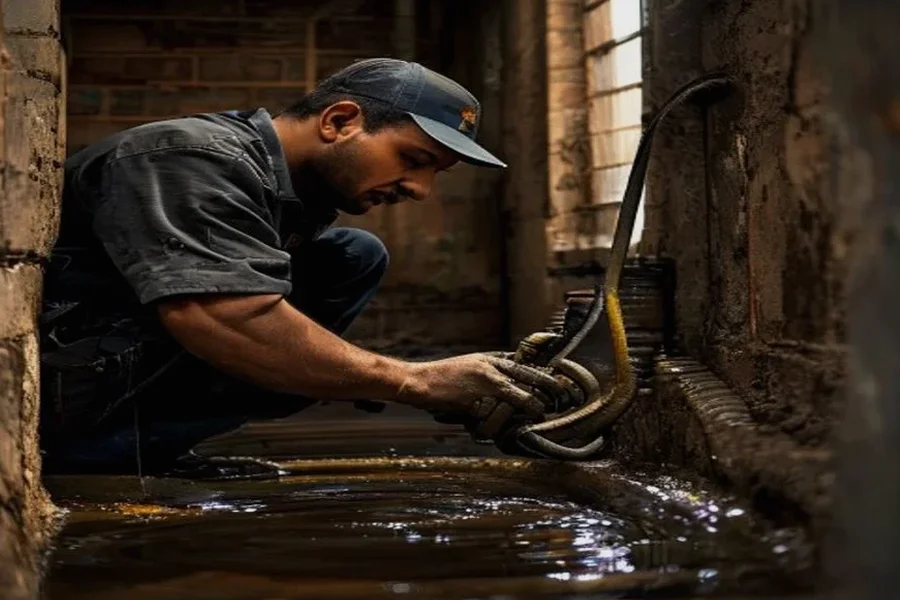
When multiple drains slow at once, the problem is not a branch line — it is the main sewer lateral carrying every drop of wastewater from your home out to the city sewer main. Our licensed technicians use power rodding machines, mechanical root cutters, and hydro jetting equipment matched to what is actually in your pipe. Flat-rate pricing with no overtime charges, ever. Part of our complete service lineup at Indy Drain Pros. All Sewer Line Cleaning Indianapolis work is camera-verified, flat-rate, and guaranteed.
Sewer line cleaning cost in Indianapolis — 2026 pricing
Every job is flat-rate, quoted before work starts. No overtime fees, no weekend surcharges, no surprises. Prices below reflect our standard Marion County service area.
Power Rodding
$250 – $500
Sectional cable machine with root-cutting or spade head through the main sewer lateral. Best for grease buildup, partial root intrusion, and paper accumulation. Restores flow fast. Does not pressure-wash pipe walls.
Mechanical root cutter or spade head
Access via sewer cleanout or pulled toilet
Post-rod camera spot-check included
Most common first-line treatment
Hydro Jetting (Main Line)
$350 – $750
High-pressure water — typically 3,000–4,000 PSI — scours the pipe wall clean: grease, scale, root fiber, and mineral deposits all pulled out. Required when power rodding has been done multiple times without lasting results, or when CCTV inspection shows root fiber coating the pipe interior.
Pressure-washes the full pipe diameter
Removes what rodding leaves behind
Pre-inspection via camera required
Results last 2-3 years on average
Camera Scope Only
$125 – $295
Standalone CCTV inspection with locator marking and written report. Required for real estate transactions, insurance claims, or when you need to document pipe condition (offset joints, pipe belly, partial collapse) before deciding on repair vs. replacement.
HD recording with timestamp
Pipe locator marks depth and location
Written condition report provided
Post-clean spot-check included free with any cleaning
All prices are flat-rate — no overtime, no holiday surcharges. Final price quoted on-site after cleanout access is confirmed.
What's in the ground
Indianapolis sewer laterals — what's actually underground in your neighborhood
The pipe material under your home determines how it fails and which cleaning method works. Indianapolis has three distinct generations of sewer lateral, and they do not behave the same way.
Pre-1950
Vitrified clay tile — the original Indianapolis lateral
Homes built before 1950 almost universally have vitrified clay pipe (VCP) sewer laterals — short 2-foot sections joined with bell-and-spigot connections packed with oakum or lead. At 75-100 years old, these joints have separated, cracked under freeze-thaw cycles, and been infiltrated by root systems. Neighborhoods most affected: Broad Ripple, Irvington, Fountain Square, Crown Hill, and the older sections of Meridian-Kessler and Butler-Tarkington. Marion County's shrink-swell clay soil — which expands when saturated and contracts during summer drought — continuously stresses these rigid clay joints, causing offset joints and back-pitch (sections where the pipe no longer slopes toward the city main).
1950–1980
Cast iron and Orangeburg — the transition era
Post-war construction through the 1970s brought two materials in Indianapolis: cast iron for higher-end builds and Orangeburg pipe — compressed wood pulp and pitch — for tract housing and mid-century subdivisions. Cast iron has a 75-100 year rated lifespan but corrodes from the inside out, particularly at the crown (the top of the pipe interior), where hydrogen sulfide gas produced by anaerobic bacteria converts to sulfuric acid in a process called crown corrosion. Orangeburg is the more urgent problem: its rated lifespan was 30-50 years, meaning every Orangeburg lateral in Marion County is past expiration. These pipes delaminate and collapse inward rather than cracking, and camera inspection frequently finds a pipe belly or partial collapse that rodding cannot fix.
Post-1980
PVC SDR-35 — modern construction
Homes built or with replaced sewer laterals after 1980 typically have PVC SDR-35, a rigid schedule-rated plastic pipe with gasket-sealed joints. PVC SDR-35 does not corrode, does not crack under root pressure the way clay does, and carries a rated lifespan exceeding 100 years under normal conditions. Root intrusion still occurs at gasket joints if the joint was improperly seated during installation or has shifted. Grease accumulation is the more common cleaning reason in PVC lines. Before any excavation near a buried sewer, contact Indiana One Call 811 at least 2 business days in advance — this is required by Indiana state law.
The most common cause
Root intrusion in Indianapolis sewer lines — scope of the problem
Root intrusion is not a slow, gradual problem. Under the right conditions, a hairline crack in a clay tile joint becomes a full root mass within two growing seasons.
Which trees cause the most damage
Silver maple and Norway maple are the most destructive root systems in Indianapolis residential neighborhoods. Both species produce aggressive, shallow lateral roots that can extend 2-3 times the height of the tree in diameter — a 40-foot silver maple can have roots probing 80 feet from the trunk. Cottonwood, which grows along drainage corridors near White River and Fall Creek, produces even longer root runs. These species sense the warm, nutrient-rich vapor escaping from clay tile joints and grow directly toward the pipe. Once inside, roots branch into a fibrous mass — fine root fiber coats the pipe wall and catches grease and toilet paper, while thicker root masses at the joint can eventually fracture the clay tile and cause a full collapse.
Silver maples are particularly common in Broad Ripple, Crown Hill, and Irvington, where the street tree canopy planted in the 1920s-1940s has created exactly the root environment that clay tile sewer laterals cannot withstand.
Root mass vs. root fiber — why the distinction matters for treatment
Root intrusion presents in two distinct stages that require different cleaning approaches. Root fiber is the early stage: fine, hair-like roots coating the interior of the pipe and beginning to accumulate debris. Power rodding with a root-cutting head breaks through root fiber and restores flow, but leaves a thin fiber layer on the pipe wall. Hydro jetting at 3,000+ PSI is required to fully clear root fiber from the wall surface.
Root mass is the advanced stage: a dense root ball that has grown through a joint, often hardening over multiple seasons. Mechanical root cutting is required first to break the mass, followed by hydro jetting to clear the debris. If the root mass has caused a pipe belly or an offset joint — visible only on CCTV inspection — pipe repair or lining may be needed in addition to cleaning.
Seasonal variation matters too: root growth accelerates in spring and early summer when soil moisture is high. Homeowners with known root intrusion history often schedule preventive cleaning in March-April before summer growth peaks.
Method comparison
Power rodding vs. hydro jetting a sewer line — the honest comparison
Both methods clear blockages. They do not do the same job, and one costs more than the other for a reason.
Power Rodding
A sectional steel cable — typically 3/4" diameter for a main sewer line — is driven through the pipe by a drum machine. A cutting head on the end (root cutter, spade, or spiral) mechanically breaks through the obstruction.
Best for: Grease accumulation, paper clogs, moderate root intrusion, first-time cleaning of an unknown line
What it leaves: Clears the center of the pipe but does not scour the walls — grease film and root fiber remain on pipe interior
Cost advantage: $250-$500, faster mobilization
Result duration: 12-24 months for root-prone lines, longer for grease-only situations
Limitation: Cannot clear root fiber coating or heavy scale; will not rehabilitate a grease-coated pipe wall
Hydro Jetting
A high-pressure water line with a rear-facing nozzle head is pushed into the pipe. Water at 3,000-4,000 PSI jets backward, propelling the head forward while scouring the pipe wall in a 360-degree pattern.
Best for: Grease-coated pipe walls, root fiber removal, recurring clogs where rodding has not held, pre-lining preparation, restaurant laterals
What it leaves: A pipe wall as close to original interior diameter as possible — scale, grease, root fiber, and mineral deposits all cleared
Cost: $350-$750 — higher because it requires camera pre-inspection to confirm pipe can withstand pressure
Result duration: 2-3 years average; longer in PVC lines
Limitation: Requires a camera inspection first — hydro jetting into a collapsed or severely cracked Orangeburg pipe can cause further damage
Our recommendation: For a first call on a backed-up main sewer line, power rodding is the appropriate starting point. If the line backs up again within 12 months, or if the CCTV inspection shows root fiber or grease coating the pipe wall, hydro jetting is the correct next step. A licensed technician will assess the line condition after camera inspection and recommend the method that will hold longest for your specific pipe material.
Our process
How we clean a main sewer line — from first call to flow confirmation
Four steps. Different equipment than a standard drain call. Larger cable, larger cutting heads, and a CCTV camera before we leave the property.
01
Cleanout access
We locate the sewer cleanout — typically a 4" cap in the yard, driveway, or basement floor — and establish access. If no cleanout exists (common in pre-1970 Indianapolis homes), we access via pulled toilet or can install a wye fitting cleanout. Before any exterior digging, we confirm Indiana One Call 811 clearance.
02
Camera pre-inspection
A CCTV camera runs through the line before cleaning begins. This identifies the blockage type — root mass, grease accumulation, pipe belly, or offset joint — and confirms the pipe can safely receive the planned cleaning method. Hydro jetting is never applied to a collapsed or severely fractured line.
03
Power rodding or jetting
Cleaning method is selected based on what the camera showed. Root intrusion gets a root-cutting head first, then a follow-up pass with a spade or chain-flail head. Grease-dominant lines go directly to hydro jetting. The licensed technician runs the equipment and monitors resistance and flow the entire time.
04
Post-clean camera verification
The CCTV camera runs the full length of the cleaned line before we leave. We confirm the obstruction is cleared, the pipe is flowing at grade, and no secondary issues (additional offset joints, pipe belly sections) were uncovered during cleaning. You see exactly what we see.
Warning signs
Signs your Indianapolis sewer line needs cleaning now
Each symptom below points to a specific failure mode in the sewer lateral. Recognizing the pattern tells you how urgent the situation is.
01
Gurgling after the washing machine runs
When the washer discharges 15-30 gallons of water rapidly into the drain system, the surge reveals a partial blockage that slower drains hide. Air is being pushed backward through a P-trap or floor drain because the main sewer lateral cannot accept the volume fast enough. A gurgling toilet or floor drain immediately after a wash cycle is a reliable early indicator of a developing sewer line blockage — often root intrusion at a clay tile joint.
02
All fixtures draining slowly at once
A single slow fixture is a branch line clog. When the kitchen sink, bathroom sink, and tub are all draining slowly at the same time, the blockage is in the main sewer line downstream of every fixture's branch connection. This symptom is especially common in Irvington and Crown Hill homes where clay tile laterals have accumulated decades of grease film over partial root intrusion, reducing the effective pipe diameter by 50% or more before flow stops entirely.
03
Sewage smell in the basement or near floor drains
A sewage smell without visible backup usually means hydrogen sulfide gas — produced by anaerobic bacteria breaking down organic matter in a partial blockage — is venting backward through a dry P-trap or a cracked building drain. In cast iron lines, hydrogen sulfide accelerates crown corrosion, where the acid attacks the upper half of the pipe interior. If the smell appears after heavy rain, it may indicate groundwater infiltration through a failed sewer lateral joint pushing sewer gas into the house.
04
Sewage backing up at the basement floor drain
This is the main sewer line failing entirely. The lowest drain in the house — typically the basement floor drain — becomes the overflow point when the sewer lateral is fully blocked. Stop running all water immediately, including dishwasher and washing machine. This situation requires same-day service. A full backup often reveals that power rodding alone has not been holding — the underlying cause is usually a root mass, a pipe belly trapping solids, or an offset joint that has been getting progressively worse.
05
Lush green grass or wet spots in a line over the sewer lateral
An unusually green strip of grass in an otherwise dry lawn, or standing water over the buried sewer line, indicates the lateral is leaking. The wastewater is fertilizing the soil directly, producing the green strip pattern. This symptom often accompanies root intrusion — roots break into clay tile joints, the joint seals open further, and eventually the pipe itself fractures. CCTV inspection is needed to determine whether cleaning and root treatment will hold or whether the lateral requires repair or replacement.
Sewer Line Cleaning by city
Sewer Line Cleaning across our top 10 Indianapolis-area cities
Same flat-rate everywhere — but lateral materials, canopy density, and historic-plumbing patterns vary by city. Each page covers per-city pricing + local detail.
How often should I have my main sewer line cleaned?
Older Indianapolis homes — those with mature trees, clay tile laterals, or built before 1985 — should have the main sewer line cleaned every 18-24 months. Newer construction can typically go 24-36 months between cleanings. Homes with a recent backup history should clean annually until the pattern stops, then drop to the standard cadence.
What causes Indianapolis sewer lines to back up?
Three main causes. First: tree roots growing into joints, especially in older clay tile laterals common in Irvington, Crown Hill, Garfield Park, and Meridian-Kessler. Second: grease and food buildup from kitchen lines coating the main. Third: pipe damage (cracks, bellies, collapses) from age or ground settling. Camera inspection tells us which.
What's the difference between drain cleaning and sewer line cleaning?
Drain cleaning addresses a single fixture's branch line — a kitchen sink, a tub, a toilet. Sewer line cleaning addresses the main 4-6" pipe carrying every drop of wastewater from the entire house out to the city sewer or septic. If multiple drains slow at once or sewage backs up at a floor drain, you need sewer cleaning.
Do you camera-scope the line during cleaning?
Yes — every sewer line cleaning includes a basic post-clean camera spot-check at no extra charge. If you need a full HD camera inspection with locator marking and written report (often required for real estate transactions), that's our separate sewer camera inspection service at $200-$350.
Cross-coverage
Other Indianapolis services & Sewer Line Cleaning in other cities
Need a different drain service or sewer line cleaning in a specific Indianapolis-area city? Jump straight to the right page.