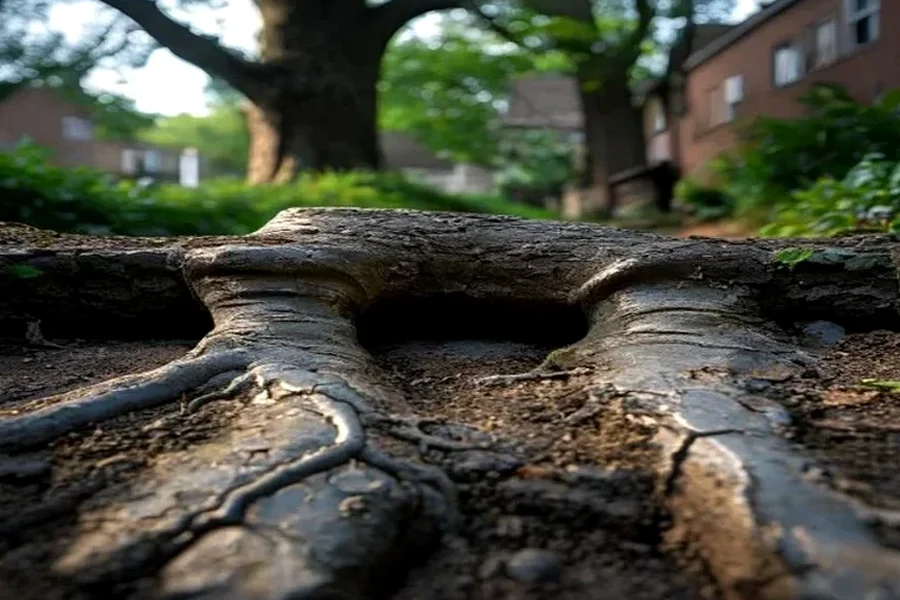
1880s-1930s Historic District clay tile. Almost every Irvington home in the Historic District core was built between 1880 and 1930, when Indianapolis's east-side trolley line drove residential expansion along the Washington Street corridor. Public sewer reached the neighborhood as those homes were going up, and the standard residential lateral material was vitrified clay tile — bell-and-spigot pipe in 4-foot lengths. After a century-plus of service, joint compound has deteriorated at most joints, creating entry points for any root tip nearby. The original 1880s laterals on Audubon Road, Bonna Avenue, Bolton Avenue, Ritter Avenue, Layman Avenue, and the side streets that ring the Historic District are still in service and still failing in the same predictable way. Need more context on this neighborhood? See our full Irvington service area for the full coverage map.
One of the densest mature canopies in Indianapolis. Irvington's tree canopy — silver maple, oak, sycamore, willow, mulberry, and the occasional honey locust — was planted as the neighborhood was being built. A century of growth means the canopy is now older than the city's drain ordinance. Silver maple is the dominant root offender — fast-growing, wide-spreading, finds sewer lines from 50+ feet away. The Historic District streetscape is specifically protected; mature trees are not getting removed, so the root pressure on every clay lateral is permanent.
The Washington Street main-sewer geometry. Most Irvington laterals run long historic routes through the front yard to reach the Washington Street trunk sewer — typically 80-120 feet of clay tile from the foundation to the city main. Longer laterals mean more bell-and-spigot joints (one every 4 feet) and more potential entry points. The Pleasant Run watershed runs through the south side of Irvington, with its own moisture profile that intensifies root growth in the adjacent blocks.
The result is the most frequent root-removal call in our service area. Irvington homeowners learn to recognize the signs early: the slow tub drain that develops over a week, the gurgling toilet after laundry runs, the basement floor-drain backup after a heavy rain. We service the same Irvington addresses on annual or 24-month rotations — annual cut + jet + foaming herbicide is the maintenance standard. For homes hitting two or more cuts a year, we walk through the CIPP lining math side-by-side so the long-term cost picture is clear.