Mechanical cutting
Drum machine with cutting head sized to the lateral (4-inch standard for LS homes). Gentle on 170-year clay — we use lighter-pressure heads on the oldest blocks. Cuts root mass back to the pipe wall. Camera confirms.
Lockerbie Square is the oldest residential district in Indianapolis. The 1855-1880s Italianate, Federal, Greek Revival, and Eastlake homes bounded by Michigan, East, New York, and College carry original vitrified clay tile sewer laterals — 140 to 170 years old, making them the oldest residential laterals we service in the metro. The cobblestone Lockerbie Street and adjacent historic-pavement blocks are nationally significant streetscape; excavation in those rights-of-way is strictly limited. The canopy of silver maple, sycamore, ginkgo, and post-Dutch-elm replacement elms keeps permanent root pressure on every joint. We cut, hydro jet the residue, then apply foaming herbicide for a 2-3 year cleared interval. Careful work around 1870s heart-pine floors, original plaster, antique millwork. Browse our service catalog or our Lockerbie Square service area. Root Removal Lockerbie Square — same flat-rate at 3 AM Sunday as 10 AM Tuesday.
1855-1880s housing stock — the oldest in Indianapolis. Lockerbie Square was platted in 1847 and built out 1855-1880s as the city's first east-of-downtown residential district. Italianate brackets, Federal symmetry, Greek Revival columns, and Eastlake jigsaw woodwork sit on lots that were laid out before the modern grid was finalized. Public sewer connections came as the homes were built, and the standard lateral material was vitrified clay tile. A century and a half later, joint compound is fully deteriorated at most joints. We're looking at the oldest residential clay-tile laterals still in service across our coverage area — 140-170 years old. Need more context on this neighborhood? See our full Lockerbie Square service area for the full coverage map.
Cobblestone Lockerbie Street + historic paving blocks. Lockerbie Street itself runs original 1880s cobblestones — a nationally significant historic streetscape that the Lockerbie Square Neighborhood Association and Indiana Landmarks have protected for decades. Adjacent blocks of Park Avenue and Vermont Street carry historic brick paving and stamped-concrete sidewalks that share the same preservation overlay. From a sewer-repair perspective, this means excavation in the cobblestone right-of-way is effectively prohibited. CIPP is the only practical method that doesn't disturb the paving. We coordinate any work that crosses the right-of-way with HLFI and the city in writing.
Short laterals, narrow lots. LS lots are 25-40 ft wide — much narrower than Meridian-Kessler's 50-80 ft frontages. Lateral runs from foundation to the alley main are short (40-70 ft) because most LS blocks route the lateral back to the alley rather than forward to the street. Short laterals mean lower per-job costs ($350-$750 cut + jet + treat range) but also tighter equipment access through narrow side yards and alley approaches. We deploy with smaller-footprint cable machines and jet rigs that fit the LS geometry.
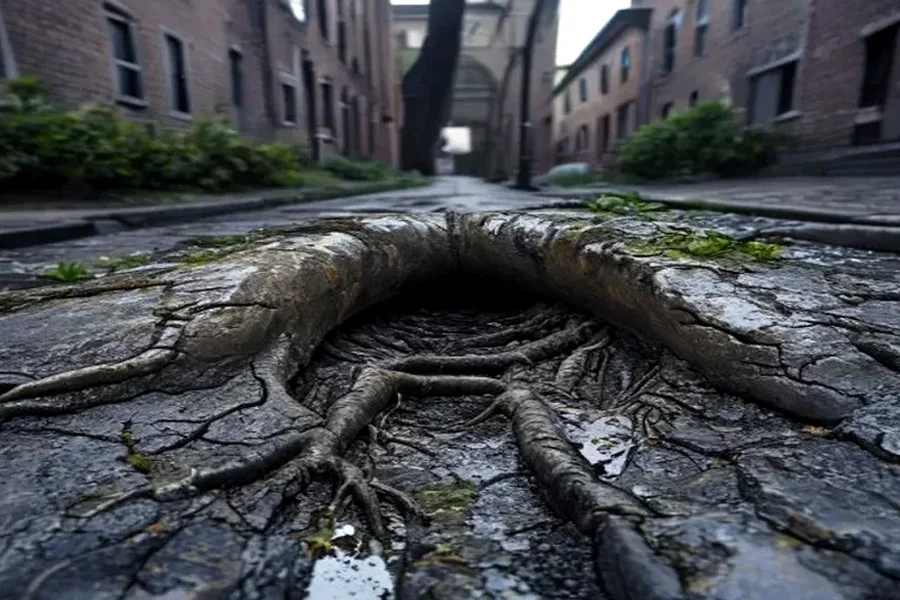
The downtown-adjacent canopy. The mature canopy along Lockerbie Street, the alley plantings between Park and East, and the front-yard street trees on Vermont — silver maple, sycamore, ginkgo on the cobblestone block, replacement elms after Dutch elm disease — keep permanent root pressure on every clay-tile joint. The LSNA actively preserves the canopy as part of the district's character. We assume root pressure is permanent and plan accordingly.
Standard cut + jet + foaming herbicide protocol. On the oldest pipe we service, the treatment step matters more than ever — clean joints stay clean longer when the foam coats every entry point.
Drum machine with cutting head sized to the lateral (4-inch standard for LS homes). Gentle on 170-year clay — we use lighter-pressure heads on the oldest blocks. Cuts root mass back to the pipe wall. Camera confirms.
4,000 PSI water jet pushes cut root residue downstream to the city main. Pipe walls clean of biofilm. Short LS laterals (40-70 ft) jet quickly — total flush time 20-30 min vs an hour on a longer M-K run.
EPA-registered copper sulfate or dichlobenil agent applied through the cleared line. Coats joint entry points, kills root tips on contact, extends cleared interval to 2-3 years from 10-15 months. Safe for the LS canopy above.
Lockerbie Square's preservation overlay strictly limits any excavation in the cobblestone right-of-way of Lockerbie Street and adjacent historic-pavement blocks. If your home is on or near those blocks, traditional dig-and-replace is effectively off the table — and pipe bursting still requires entry pits that disrupt paving. CIPP cured-in-place lining is the only practical method that leaves the cobbles untouched. The LS math is also unusually favorable: 40-70 ft short laterals × $95-$220/ft = $3,800-$15,400 one-time, often cheaper than 8-10 years of annual treatment on a 170-year-old lateral.
Standard for single-joint intrusion with sound clay tile. Right call when intrusion is mild and the math hasn't turned. Cheaper per-visit thanks to short LS laterals.
One-time fix seals every joint along the full short lateral. Required where cobblestone or historic paving rules out excavation. Often cheaper than annual treatment past year 5.
See our main sewer line repair page for full CIPP detail.
Cobblestone preservation rules out excavation. CIPP or annual treatment are the only practical paths.
Pre-purchase camera scope ($250, credited) tells you the true cost of ownership on 170-year clay tile before contract.
Vent disruption from partial root obstruction. Classic early sign on a short LS lateral.
LS homes on chronic-intrusion maintenance plans typically run a Q1 cut + jet + treatment to reset the year. We carry the file.
Same flat-rate everywhere — crews staged across the metro. Each area page covers the local pricing detail + access notes.
1855-1880s Italianate / Federal / Eastlake clay tile specialty. Cobblestone preservation prioritized. Careful work around 1870s woodwork + plaster + antique fixtures.
Call (317) 608-3777LS is the oldest residential district in Indianapolis — 1855-1880s housing with 140-170 year old original clay-tile laterals. Combined with mature canopy along Lockerbie Street and the alleys, root intrusion at deteriorated joint compound is essentially universal. Every clay-tile lateral we scope shows some intrusion.
Mechanical cutting only is $350-$450 — LS's shorter 40-70 ft laterals run at the low end. Combined with jetting and foaming herbicide is $550-$750. Same flat-rate as central Indianapolis. Upper end reflects heavier intrusion or unusually long LS laterals.
Often yes, especially on a cobblestone-paved block where excavation is effectively prohibited. LS short laterals make CIPP cheaper than other neighborhoods ($3,800-$15,400 vs M-K's $9.5-$28.5K). Camera scope tells us when the math has turned.
No. The work happens outside — at the alley-side cleanout or yard cleanout. No equipment touches interior 1870s woodwork or plaster. Drop cloths under any indoor work area. We've worked LS homes for years and know the preservation expectations.
For any work that touches the public right-of-way — cobblestone, brick paving, historic sidewalks — we notify LSNA and Historic Landmarks Foundation of Indianapolis in writing before scheduling. Trenchless work that uses existing cleanouts typically needs no coordination because there's nothing visible to coordinate over. Excavation in any historic right-of-way always involves the conversation early.
No. EPA-registered copper sulfate or dichlobenil agents stay inside the lateral, attack root tips at the joint entry point, and flush to the city main as part of normal sewer flow. They don't affect the tree above ground, trunk roots, or any adjacent landscaping. The LS canopy is preserved.
Yes. For confirmed recurring intrusion we schedule cut + jet + treatment on a 12-month rotation and price it as a maintenance plan. We carry the camera-history file. Most LS maintenance accounts switch to CIPP within 4-6 years because of the cobblestone preservation overlay + favorable CIPP math.
LS is the closest residential neighborhood to our central staging — 5-15 minutes via College Avenue, East Street, or Massachusetts Avenue. Closer than any other neighborhood we service. For declared emergencies we target arrival within 30 minutes.
Camera-diagnosed first. We tell you honestly when the LS math has tipped toward CIPP. EPA-registered foaming herbicide preserves the canopy. Cobblestone preservation respected. Careful work around 1870s heart pine, original plaster, antique fixtures.