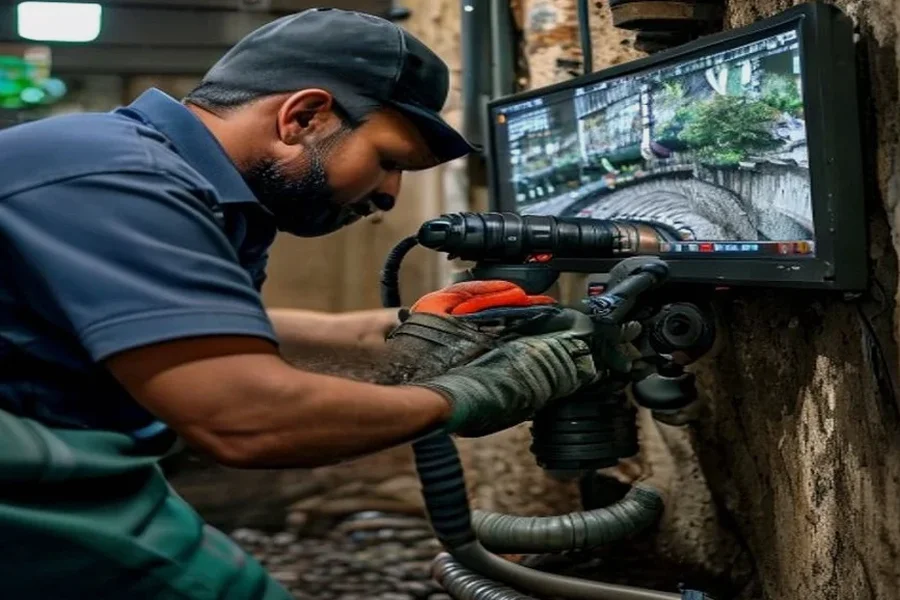
HD push-rod camera down your sewer lateral, sonde locator marking on the surface, and a written report you can hand to a realtor, contractor, or insurance adjuster. Flat-rate $125–$295 residential across Marion County and the Indy metro. Part of our complete service lineup at Indy Drain Pros — pairs with sewer line cleaning when work is needed. Standard Sewer Camera Inspection Indianapolis dispatch, 30-day clog-back guarantee.
Sewer camera inspection cost in Indianapolis — 2026 rates
Residential sewer camera inspection in Indianapolis runs $125–$295 for a standard lateral up to 100 feet, with most single-family homes landing in the $150–$250 range depending on access and footage length. Commercial lines — larger diameter, longer runs, or multiple branch laterals — typically run $200–$450 because they require a crawler camera or a heavier push-rod rig rather than a standard residential push camera.
Real estate sewer scope (pre-purchase inspection) is priced at the same residential rate. You get the same HD recording, the same sonde locator depth markings on the surface, and the same written findings — formatted so you can attach it directly to a disclosure document or negotiation letter. Most Indianapolis buyers request a scope on any home built before 1980; lenders and real estate attorneys in Marion County increasingly expect one on older properties.
After hydro jetting, the post-cleaning verification scope is included at no additional charge. Hydro jetting without a camera confirmation is like washing a car with the lights off — you cannot verify the line is clear until you look. We include that confirmation as a standard part of every jetting job.
$125–$295
Residential flat-rate (up to 100 ft lateral)
$200–$450
Commercial / large-diameter lines
Free
Post-cleaning verification after hydro jetting
Sameday
Written report + HD video file delivery
What a sewer camera can see — and what it can't
Understanding the boundaries of a push-rod camera inspection helps you make the right call on next steps. Here is what our HD camera can and cannot confirm.
What the camera definitively confirms
Root intrusion — visible root mass, fine root tendrils at joints, or root ball obstructions
Offset joints — misaligned clay tile or cast iron segments; camera confirms exact location, sonde locator confirms depth
Pipe belly location and depth — section of lateral that has settled and now holds standing water; depth reading provided via ground locating wand
Grease coating thickness — cream or yellow coating on pipe wall reducing inside diameter
Partial or full structural collapse — camera image stops advancing; immediate action required
Mineral scale and tuberculation — calcified buildup common in cast iron lines over 40 years old
Post-cleaning verification — confirms pipe wall is clear after hydro jetting
Technical limitations to understand
Only accessible pipe is inspected — the camera enters through a cleanout or pulled toilet; it cannot reach branches without a lateral launch system
Cannot see the exterior of the pipe — soil erosion, pipe coating condition, and bedding failure are not visible from inside
Cannot always determine crack depth — a longitudinal crack in clay tile is visible, but whether it penetrates through the pipe wall requires closer evaluation or dye testing
HD image quality varies with pipe debris — heavily silted lines may require flushing before a clear image is possible
Cannot inspect collapsed sections — the push-rod camera cannot pass a full collapse; a CCTV crawler may be required for main line assessment beyond the blockage
Five situations where a camera scope pays for itself
A sewer camera inspection is one of the few diagnostic tools where the cost-to-value ratio is almost always favorable. These are the five situations where Indianapolis homeowners and buyers consistently say the scope was worth every dollar.
1. Recurring clog — third drain call in 12 months
When clearing the clog keeps coming back, the camera shows whether the real problem is root intrusion growing back through a joint, a pipe belly accumulating sludge, or a structural issue that no amount of cleaning will solve. Stops the cycle of service calls.
2. Multi-fixture backup — every drain affected at once
When toilets, tubs, and floor drains all back up simultaneously, the blockage is in the main lateral, not a branch line. The camera locates the exact defect — offset joint, root ball, or collapse — so repair decisions are made on facts, not guesses.
3. Pre-purchase home inspection — real estate sewer scope
Traditional home inspectors do not enter the pipe. A $150–$250 scope on an older Indianapolis home with clay tile laterals can uncover issues worth $6,000–$15,000 to repair. Buyers routinely use written findings to negotiate seller credits or price reductions.
4. Post-sewage-backup documentation for insurance
After a sewage backup event, insurance adjusters frequently require visual documentation of the cause. The HD video recording and written report showing the defect — offset joint, grease blockage, or collapsed section — gives your insurer exactly what they need to process the claim.
5. Pre-lining verification — required before trenchless repair
Cured-in-place pipe lining (CIPP) and pipe bursting require a clean, structurally sound host pipe. The pre-lining inspection confirms the pipe qualifies for trenchless repair — preventing a liner installation failure that would cost far more than the scope itself.
How the inspection works — cleanout to written report
From the time we arrive to the time you have a written report in hand, most residential sewer camera inspections in Indianapolis take 45–60 minutes total. Here is exactly what happens.
1
Cleanout access
We locate the main cleanout — typically in the basement near the front foundation wall, or in the yard close to the house. Homes without a cap or accessible cleanout may require pulling a toilet to create entry; we carry the tools to do this without damage. Access usually takes 5–10 minutes.
2
Push-rod camera feed and live monitor review
The push-rod camera — a flexible fiber optic cable tipped with an HD camera head — is fed into the pipe from the cleanout. Our technician watches the live video feed on the monitor and narrates every finding in plain language. You are welcome to stand next to the monitor and watch. Defect locations are noted by footage count on the reel drum display. The DVR records the entire run from entry to the end of the accessible lateral.
3
Surface locating with sonde transmitter and ground locating wand
The camera head contains a sonde — a locator transmitter that broadcasts a radio signal. Our technician walks the surface with a ground locating wand to pinpoint the camera's position directly above ground level. For every significant defect found, we mark the surface location and record the depth reading. This tells you exactly where to dig if excavation is required, and confirms where not to dig if you are planning landscaping or a foundation project.
4
Written report and HD video footage delivery
You receive a written findings report with defect descriptions, footage-count locations, surface depth readings, and a repair recommendation for each finding. The HD video file is delivered the same day via email or download link. The report is formatted to be handed directly to a real estate agent, contractor, or insurance adjuster — no translation needed.
Indianapolis pipe conditions our cameras find most often
Indianapolis has a distinct sewer pipe inventory shaped by its development timeline. Pre-war and post-war construction patterns mean that the type of problem — and how urgent it is — often varies by neighborhood. Here is what our cameras encounter most in the field.
Clay tile joint offsets — Irvington, Crown Hill, Fountain Square
Pre-1950 neighborhoods on Indianapolis's east and near-west sides were built almost exclusively with vitrified clay tile laterals laid in 3-foot segments. Frost-heave cycles and settlement shift the bell joints out of alignment — a classic offset joint. Water still flows, but roots enter easily and grease builds at every misalignment. When the offset exceeds roughly a third of the pipe diameter, the line becomes a lining candidate rather than a cleaning candidate.
Cast iron scale and tuberculation — Meridian-Kessler, Butler-Tarkington
1920s–1940s construction in north-side Indianapolis neighborhoods used cast iron pipe for both the house drain stack and the first section of the lateral. After 80–100 years, the interior of cast iron develops tuberculation — a rough, coral-like mineral scale that reduces flow capacity and collects grease. The camera shows severe narrowing that cleaning alone cannot reverse. These are strong pre-lining inspection candidates.
Homes built 1945–1960 in Indianapolis often have Orangeburg pipe — a bituminous fiber material that delaminated and collapsed decades ahead of schedule. The camera reveals an oval or egg-shaped cross-section where the pipe wall has softened and deformed. There is no cleaning fix for Orangeburg collapse; it requires replacement or, where the pipe is still mostly round, CIPP lining. This finding ends the "monitor it" conversation immediately.
Root intrusion from silver maple and cottonwood
Silver maple and cottonwood are among the most common street and yard trees across Marion County — and among the most aggressive root systems relative to clay tile sewer laterals. Their fine feeder roots penetrate open joints within years of planting, then expand each season. The camera shows the progression clearly: fine root tendrils at a joint, to a full root ball filling 60–80% of the pipe cross-section, to a complete blockage. Root intrusion alone does not require pipe replacement if the joint is otherwise intact; it is the most common situation where hydro jetting plus post-cleaning verification extends pipe life significantly.
What the camera report includes — and what we recommend based on findings
Every Indy Drain Pros camera inspection produces a written findings document, not a verbal summary. The report uses a PACP-style rating framework — the same Pipeline Assessment Certification Program grading system used by municipal utilities — so the findings are meaningful to contractors, engineers, and adjusters, not just to homeowners.
CIPP lining if still round; excavation and replacement if oval or crushed
Full structural collapse
Grade 5
Excavation and replacement; no trenchless option past a full collapse
Where the camera shows a line in good condition — no defects, good grade, clean pipe wall after a flush — we say that too. The written report will indicate the pipe is in serviceable condition with a recommended re-inspection interval. We do not manufacture findings to sell repairs.
For lining candidates, the camera report travels directly to the lining estimate — no second visit required. For excavation candidates, the surface markings from the sonde locator and ground locating wand give excavation crews an exact dig location and depth before the first shovel hits the ground.
Camera scope is available as a standalone service or paired with sewer line cleaning and hydro jetting as part of a single visit. Call (317) 608-3777 to schedule. Same-day appointments are available across Indianapolis and Marion County.
Sewer Camera Inspection by city
Sewer Camera Inspection across our top 10 Indianapolis-area cities
Same flat-rate everywhere — but lateral materials, canopy density, and historic-plumbing patterns vary by city. Each page covers per-city pricing + local detail.
How much does a sewer camera inspection cost in Indianapolis?
Residential sewer camera inspection in Indianapolis runs $125–$295 flat-rate for a standard lateral up to 100 feet. Real estate sewer scope reports — with sonde locator marking, full HD recording, and written findings — sit at the upper end. Post-cleaning verification after hydro jetting is included at no added charge.
Why would I need a sewer camera inspection?
Five main reasons: recurring clogs that keep coming back, multi-fixture backups, pre-purchase home inspection on an older Indianapolis property, post-sewage-backup insurance documentation, or pre-lining verification before trenchless pipe repair. The footage confirms exactly what is in the pipe before anyone digs.
How long does a sewer scope take?
Most scopes take 30–45 minutes from cleanout access to verbal findings. The written report with sonde locator depth readings and recorded HD footage is delivered the same day. Locating a cleanout without a cap adds roughly 15 minutes.
Will you give me the video footage?
Yes — every camera inspection includes the recorded HD video file delivered via email or download link, plus a written findings report. You own the footage and can share it with realtors, contractors, or insurance adjusters.
Cross-coverage
Other Indianapolis services & Sewer Camera Inspection in other cities
Need a different drain service or sewer camera inspection in a specific Indianapolis-area city? Jump straight to the right page.
Sewer Camera Inspection Carmel
Sewer Camera Inspection Fishers
Sewer Camera Inspection Greenwood
Sewer Camera Inspection Noblesville
Sewer Camera Inspection Downtown Indy
Same-day available
See exactly what's down there.
HD video, sonde locator depth marking, written report — delivered same day. The footage is yours.