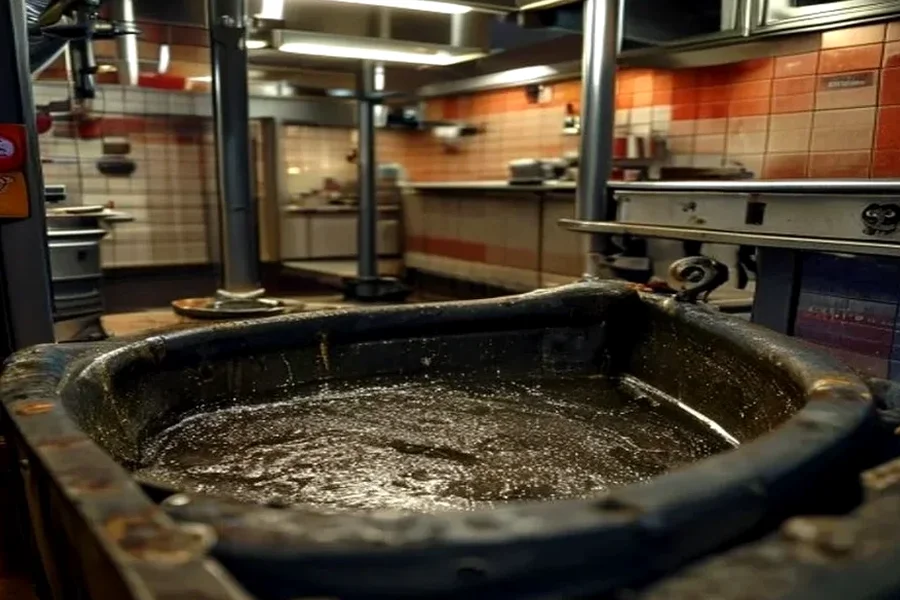
Setting the right cleaning schedule for your Indianapolis restaurant
The correct service interval is not arbitrary — it is a function of your trap size, your kitchen's FOG loading rate, and the 25% capacity rule. Here is how to think through your own schedule.
Step 1 — Know your trap size. Under-sink grease traps in commercial kitchens are typically 20–50 gallons. In-ground grease interceptors at full-service restaurants and larger food service facilities are commonly 1,000, 1,500, or 2,000 gallons. If you do not know your interceptor capacity, check the manufacturer plate on the access lid or call us — we will measure it on the first visit.
Step 2 — Estimate your FOG loading rate. The primary drivers of FOG accumulation are covers per day and fryer count. A restaurant serving 200 covers per day and running three active fryers will load a 1,000-gallon interceptor significantly faster than a 75-cover cafe with a single fryer. Bakeries, meat processors, and hotel banquet kitchens also carry elevated FOG loading rates relative to their cover count because of the fat content in their primary processes.
Step 3 — Apply the 25% trigger. At 25% of 1,000 gallons, the trigger point is 250 gallons of accumulated FOG and solids. A high-volume kitchen generating 8–10 gallons of FOG per day hits that threshold in roughly 30 days. A moderate-volume operation generating 3–4 gallons per day reaches it in 60–90 days. A light-use kitchen — a bar serving limited food, a coffee shop — may safely run a quarterly cycle.
What happens when you under-service. A 30-day kitchen on a 90-day schedule will blow past the 25% threshold by the second month. The consequences arrive in sequence: emulsified grease begins bypassing the trap, the FOG discharge line builds up with biofilm and hardened grease, the kitchen lateral slows, and eventually a full backup occurs. Every step in that sequence is more expensive and disruptive than the pump-out that would have prevented it. Restaurants that have experienced a backup during service understand this trade-off viscerally.
On the first service visit, we review your trap capacity, discuss your kitchen's output, and recommend a service interval calibrated to your operation. Restaurants on a maintenance contract receive a scheduled service window — the same time slot every cycle — so the manager does not need to track it independently.