$150-$350
Flat-rate range for accessible drain cleaning
45-90 min
Typical time on-site, arrival to cleanup
30days
Clog-back guarantee on every standard service
0chemicals
No Drano, no caustics — mechanical cabling only
2026 pricing

What drain cleaning costs in Indianapolis — 2026 pricing

Every job is quoted flat-rate before a wrench turns. The same price applies at 2 a.m. on a Sunday as it does at noon on a Tuesday — no overtime fees, no surprise charges.

Service What's included Flat-rate range
Single drain — bathroom sink, tub, or shower Cable machine + cutting head sized to line + flush test + cleanup $150 – $350
Kitchen sink + disposal line Cable from cleanout past grease accumulation zone + hot-water flush verify $175 – $275
Toilet — clog beyond the plunger Closet auger for trap clogs; branch cable when auger isn't enough $175 – $300
Main sewer line cleaning Drum auger through cleanout + full-flow flush test $300 – $550
Hydro jetting High-pressure water jetter at 3,000–4,000 PSI + camera scope before and after $350 – $750
Camera scope (add-on or standalone) HD push-camera + locator + digital report to you +$150 – $250

Hydro jetting and main sewer line work are priced separately from standard drain service. If the camera reveals pipe damage, root intrusion, or an offset joint, we'll quote any additional repair before anything starts. See the sewer line cleaning page and the hydro jetting page for full detail on those services. Every job on our complete service list carries the same flat-rate, no-surprise commitment.

Choosing the right method

Drain snake vs. hydro jetting — which does your clog need

Cable machine (drain snake)

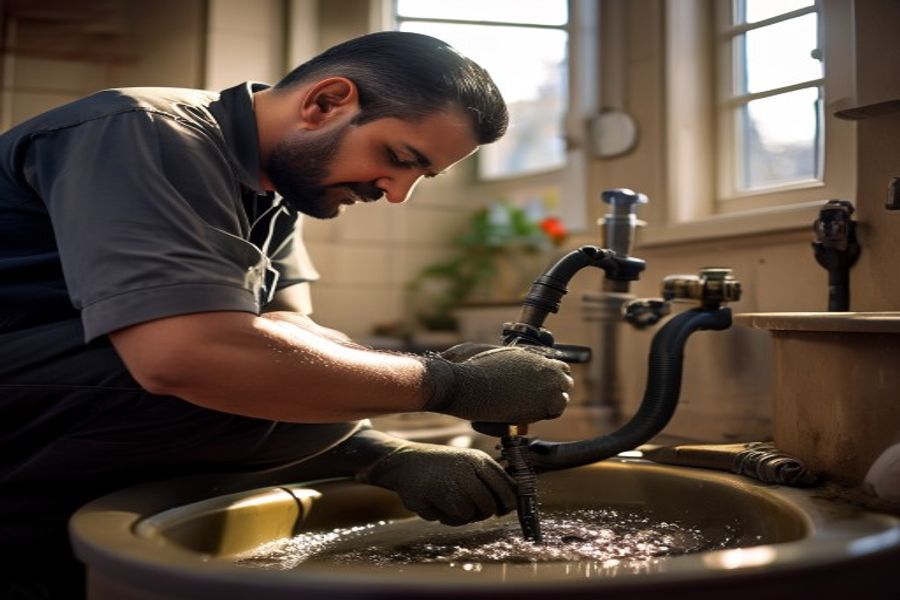
A motorized drum auger feeds a flexible steel cable into the pipe. Rotating cutting heads — bulb, spade, root-cutter — bore through or pull back the obstruction. A hand auger handles surface clogs in sinks and tubs; a heavy-duty drum auger is what clears a 4" main. We size the cable diameter and head to the line every time. Cable work is the right call for hair blockage in a tub drain, a grease plug in a kitchen line that isn't years-deep, a toilet clog a closet auger can't reach, and any branch line where the pipe material (especially older cast iron or PVC) is healthy but blocked.

Cable machines physically remove the clog. They don't clean the pipe walls. If grease accumulation or mineral scale has narrowed the bore significantly — common in older Marion County homes with cast iron waste lines — cabling clears the blockage but leaves a rough interior surface that rebuilds fast.

Hydro jetting

A hydro jetter forces water at 3,000–4,000 PSI through a self-propelling nozzle that simultaneously blasts forward and backward. It scours pipe walls clean — grease accumulation, soap scum deposits, mineral scale from Central Indiana's moderately hard water, and biofilm all come off the wall. The result isn't just a cleared blockage; it's a clean pipe bore close to its original interior diameter.

Hydro jetting is the right tool when a camera scope shows heavy grease coating, when a line has been cabled multiple times in the same season, when tree roots are present (the water pressure flushes root debris after cabling), or when you're dealing with scale buildup in a hard-water section of the Indianapolis metro. One important constraint: we always scope the pipe before jetting. Sending 4,000 PSI into a compromised clay tile lateral, a section of deteriorated orangeburg pipe, or a cast iron line with advanced corrosion can split the joint or collapse the pipe. If the camera shows structural issues, CIPP lining or pipe replacement is the conversation — not jetting.

Not sure which your situation needs? Call us — (463) 331-0700 — and describe what you're seeing. We'll tell you on the phone, no charge.

Local context

The most common drain clogs in Indianapolis homes

Grease accumulation and soap scum

Kitchen drain failures account for roughly a third of the calls we take across Marion County. Cooking grease and fat enter the line warm and liquid, cool on the pipe wall, and build layer by layer. Soap scum — the insoluble calcium salt formed when soap meets hard water — coats bathroom lines the same way, just more slowly. Neither responds to boiling water poured down the drain in any meaningful, lasting way. Both need a cable or hydro jetter to clear properly.

Hair blockage and soap scum in tubs and showers

Hair binds with soap residue at the P-trap or drum-trap, forming a plug that gets denser each week. A 25-foot hand auger reaches most bathroom tub clogs. Shower drains with long trap arms or branch lines that run more than 10 feet before the main stack need a powered cable machine. We use a bulb-head or retrieval head — not a spade or root cutter, which shreds hair rather than pulling it back out.

Tree roots in clay tile and cast iron laterals

Indianapolis's older neighborhoods — Irvington, Meridian-Kessler, Fountain Square, Broad Ripple — were sewered primarily with clay tile and cast iron in the early and mid-twentieth century. Both materials joint rather than fuse, and those joints open over decades of ground movement. Marion County's expansive shrink-swell clay soil amplifies this: the same soil that heaves sidewalks in wet springs contracts in dry summers, rocking pipe joints open just enough for tree roots to enter. Once inside, roots fill the bore in a season. Cabling cuts them back; hydro jetting flushes the debris; a camera scope tells you whether the joint damage has progressed to the point where repair or CIPP lining is the smarter long-term move.

Mineral scale in older cast iron and galvanized lines

Indianapolis water is moderately hard — enough that mineral scale builds on the interior of cast iron and galvanized steel drain lines over decades. A 3-inch cast iron stack that has never been cleaned can narrow to a 2-inch effective bore or less. Scale doesn't respond to cabling alone; the hydro jetter's high-pressure nozzle is the mechanical equivalent of pipe descaling, scouring the calcite and carbonate deposits from the wall. If a newly cabled drain slows again within weeks, mineral scale is usually the explanation.

Pipe bellies, offset joints, and orangeburg pipe

A pipe belly is a low spot where the drain line has settled below its original grade — common in older Marion County properties where the shrink-swell clay has shifted the soil under the slab or crawlspace. Waste pools in the belly, solids collect, and recurring slow drains follow. Offset joints (where one pipe section has shifted laterally relative to the next) create a partial blockage and a root-entry point simultaneously. And then there's orangeburg pipe — a bituminous fiber material installed from the 1940s through the early 1970s that degrades from the inside out, eventually delaminating into a soft, collapsing oval. If your home was built before 1975 and has never had a sewer camera inspection, we'd strongly recommend one. See camera inspection service for details.

Foreign objects and misused fixtures

Wipes — even those labeled "flushable" — don't break down in Indiana plumbing code-compliant 3" and 4" drain lines the way toilet paper does. Paper towels, feminine hygiene products, and dental floss are the other common culprits. In kitchens, eggshells, coffee grounds, and fibrous food (celery, artichoke) combine with grease to create a dense plug past the disposal. A closet auger or drum auger retrieves most of these in a single service call. PVC drain lines installed to current Indiana plumbing code tolerances handle this well; the concern is always older cast iron or clay tile where pulling a dense foreign-object clog risks cracking the pipe at a corroded joint.
Our process

How Indy Drain Pros clears a drain — step by step

Every licensed technician follows the same sequence. No shortcuts, no guessing.

1

Diagnose before touching the line

We ask about the symptom pattern — which fixtures are slow, whether multiple drains are affected, and how long it's been building. Multiple fixtures backing up simultaneously means a main-line or sewer issue, not a fixture problem. Same-day dispatch gets the right equipment in the truck. If the symptom profile suggests a camera scope is warranted (recurring clog, possible pipe belly, older clay tile or orangeburg lateral), we say so before arriving — not after opening your cleanout.

2

Access the cleanout and size the equipment

We locate the nearest accessible cleanout or pull the stopper on the fixture. Cable diameter and cutting head are matched to the pipe — a 1/4" cable and bulb head for a tub drain, a 1/2" or 5/8" cable with a root-cutter for a kitchen branch, a heavy-duty drum auger for a 4" main. The closet auger goes in first on toilet calls; it's the right tool for trap-area blockages and keeps us from dropping a cable machine into a toilet flange unnecessarily.

3

Clear the blockage — cable or hydro jet

The cable feeds in under power, the technician reads feedback through the machine to feel where the obstruction is and what it's made of. Hair pulls back; grease accumulation breaks up and flushes; tree roots require the cutting head to pass through multiple times. If we quoted hydro jetting, the high-pressure water jetter goes in after cabling to scour the pipe walls clean. We never substitute one method for another without telling you and re-quoting if the price changes.

4

Camera verify (when applicable)

On main line calls, recurring clogs, and any job where the pipe material is cast iron, clay tile, or unknown, we run a push-camera through the cleared line. The camera confirms full flow, checks joint condition, and identifies any pipe belly or offset that explains why the clog keeps coming back. You see the footage. We'll tell you exactly what's there — and whether it needs further action under Indiana plumbing code or can wait. This isn't an upsell; it's how we stand behind the 30-day clog-back guarantee.

5

Flush test, cleanup, and guarantee

Full-flow flush at every affected fixture before we leave — not a trickle from the tap, a real volume test. Workspace is cleaned up, the cleanout cap is re-seated, and you get the flat-rate invoice matching the quote you approved. The 30-day clog-back guarantee starts the moment we close the job: if the same drain clogs again within 30 days on the same issue, we come back at no charge. Same-day dispatch is available across all 35+ areas we serve in the Indianapolis metro.

When to call

Warning signs your drain needs professional service

Some symptoms are obvious. Others are easy to ignore until a second fixture backs up and you're bailing out a bathroom floor. Don't wait for that.

01

Drain is slower than it was a month ago

Gradual slowdown is soap scum or grease accumulation narrowing the pipe bore incrementally. By the time you notice it, the line is typically 50% or more blocked. A cable machine clears it in one visit.

02

Gurgling or air noises at a fixture you're not using

A toilet that bubbles when the shower drains — or a floor drain that gurgles when the washing machine empties — means the main line or branch stack is partially blocked and air is venting back through the nearest fixture. That's a sewer line call, not a single-drain call. See sewer line cleaning.

03

Sewage smell rising from floor drains or cleanouts

A floor drain with a dry P-trap will smell after a few weeks of no use — just pour a quart of water in and add a tablespoon of vegetable oil to slow evaporation. But if the smell persists after refilling, or if it's coming from a drain that gets regular use, biofilm in the pipe or a blocked vent is the likely cause. Professional cleaning removes biofilm that household drain cleaners don't reach.

04

Water pooling in the tub or on the shower floor

Standing water above the drain means flow has stopped entirely or nearly so. A hand auger from the hardware store handles surface hair blockage near the strainer. When the clog is further down — past the P-trap, into the branch line — you need a powered cable machine and the experience to feel where the obstruction ends without pushing it deeper.

05

Multiple fixtures backed up simultaneously

If two or more drains on different branch lines are slow or stopped at the same time, the blockage is in the main sewer line — not in any individual fixture. Stop using water-intensive appliances (dishwasher, washing machine) and call immediately. See main sewer line cleaning. If the backup includes sewage at the lowest floor drain, that's a 24/7 emergency call.

06

Same drain clogs repeatedly, every few months

A drain that clears and re-clogs on a short cycle has a structural explanation — pipe belly, offset joint, root intrusion at an open clay tile or cast iron joint, or severe mineral scale that cabling alone never fully removes. A camera inspection identifies which one. Spending $150–$250 on a scope often saves several seasons of repeat service calls and tells you whether CIPP lining is worth considering for the long term.

Service area

Same-day drain cleaning across 35+ Indianapolis areas

Same flat-rate everywhere we serve. Same licensed technicians, same camera-verified results. View the complete service area.

Drain Cleaning by city

Drain Cleaning across our top 10 Indianapolis-area cities

Same flat-rate everywhere — but lateral materials, canopy density, and historic-plumbing patterns vary by city. Each page covers per-city pricing + local detail.

FAQs

Drain cleaning questions Indianapolis homeowners ask

Real questions from the phone line. Don't see yours? Call us — diagnosis on the phone is always free.

Call (463) 331-0700

How much does drain cleaning cost in Indianapolis?

Standard accessible-fixture drain cleaning runs $150-$350 flat-rate. Bathroom drains land at the lower end ($150-$225), kitchen drains in the middle ($175-$275), and multi-fixture branch lines toward the top ($250-$350). Camera scope adds $150-$250 if needed. Main sewer line cleaning is a separate service ($300-$550).

How long does drain cleaning take?

Single-fixture clogs (kitchen, bathroom sink, tub, shower, toilet) typically take 45-90 minutes from arrival to cleanup. Multi-fixture branch lines run 90 minutes to 2 hours. Main sewer line cleaning is 90 minutes to 3 hours depending on access. Camera scope adds 30-45 minutes if performed.

Can I just snake the drain myself?

A 25-foot hand auger from the hardware store can clear surface clogs in bathroom sinks, tubs, and showers. For kitchen drains (grease coating beyond what hand pressure clears), deep clogs (anything more than 8 feet down), or main lines, you need a motorized cable machine and the experience to feel the obstruction without damaging the pipe. Most homeowners save time and pipe damage by calling.

Will drain cleaning damage my pipes?

Professional cable cleaning won't damage healthy pipes. The cable spins through the clog, not the pipe wall, and we size the cable + cutting head to the line. For older cast iron or clay sewer laterals, we scope on camera first if there's any concern. We never run a heavy machine through a pipe that's too fragile.

Do you offer same-day service across Indianapolis?

Yes. Calls before 4 p.m. are cleared same-day across all 35+ Indianapolis-area neighborhoods and suburbs — Marion County core plus Carmel, Fishers, Westfield, Noblesville, Greenwood, Avon, Plainfield, Zionsville, Brownsburg, and the rest. Emergency 24/7 dispatch is available everywhere with no overtime fees.

Available right now

One drain or every drain — we can clear it today.

Flat-rate pricing before any work begins. Same-day across Indianapolis. Camera-verified before we leave. 30-day clog-back guarantee.

Call (463) 331-0700 Schedule Online
$150+
Flat-rate start
24/7
Dispatch
30days
Guarantee
$0
Overtime fee