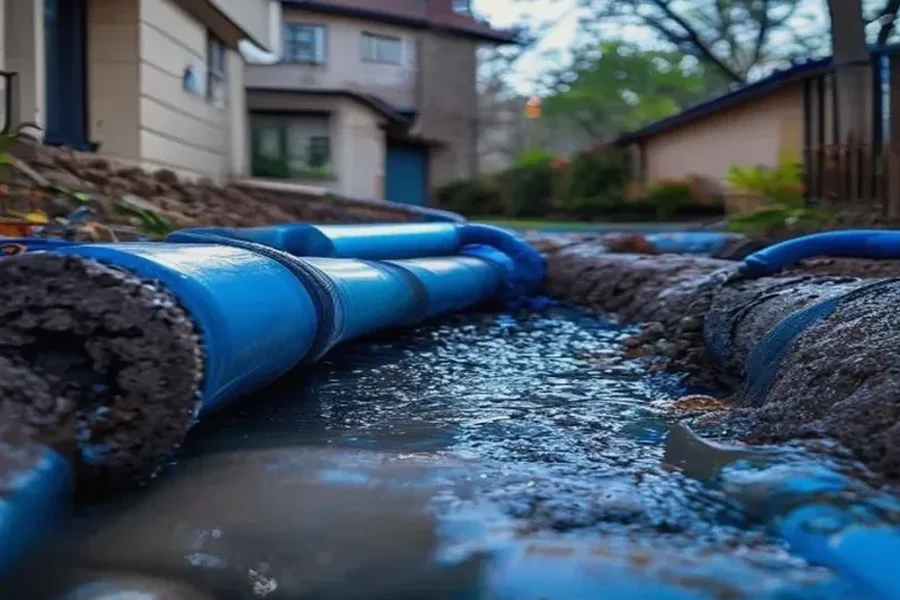
When the CCTV camera confirms a cracked, collapsed, or root-destroyed sewer lateral, repair is no longer optional. We evaluate the pipe condition, access, and soil type to recommend the right method — CIPP lining, pipe bursting, or open-cut excavation — and quote flat-rate before a single shovel hits the ground. Marion County permits pulled in your name, city inspection scheduled, Indiana 811 utility locate coordinated, and landscape fully restored. Camera-diagnosed first, always. Part of our full service lineup at Indy Drain Pros. Same-day Main Sewer Line Repair Indianapolis, flat-rate, no overtime.
Sewer line repair cost in Indianapolis — 2026 pricing by method
The repair method determines cost more than line length. Here are the current flat-rate ranges we quote in Marion County and the surrounding Indianapolis metro:
CIPP pipe lining (trenchless)
$4,500–$8,500
Standard 50-foot residential lateral · no excavation required
Felt or fiberglass liner + resin saturation
UV, steam, or ambient cure — 4–6 hour window
25–50 year manufacturer warranty, ASTM F1216 compliant
Same-day return to service
Pipe bursting (trenchless replacement)
$5,500–$12,000
Full lateral replacement via expander head · new HDPE pipe
Expander head fractures old pipe outward into soil
New HDPE SDR-17 replacement pipe pulled in simultaneously
Two small access pits — launching and receiving
50-year pipe warranty
Open-cut excavation replacement
$6,000–$18,000+
Traditional trench repair · required when trenchless isn't viable
Full excavation to pipe depth (typically 4–8 ft in Marion County)
PVC SDR-35 or HDPE replacement pipe installed to grade
Landscape, pavement, or driveway restoration included in scope
Cost varies with depth, length, and surface complexity
Spot repair / point repair
$1,200–$3,500
Isolated section repair · single offset joint or sleeve repair
Camera-pinpointed defect — one excavation, one section
CIPP sleeve / point repair liner or small dig-and-replace
Appropriate when rest of lateral scores PACP grade 1–2
Fastest resolution when the pipe is otherwise sound
Permit cost: Marion County sewer lateral permit runs $150–$400 depending on municipality and scope. We pull it, schedule the city inspection, and include the permit fee as a transparent line item in your flat-rate quote — never a surprise at invoice.
Every repair starts with a CCTV camera scope. We won't quote a repair number without seeing the pipe. Camera inspection runs $125–$295 and is credited toward repair if you proceed with us.
Trenchless vs. traditional — which repair method fits your pipe
There is no single right answer. Five factors determine whether we recommend CIPP lining, pipe bursting, or open-cut excavation:
Collapsed sections, severe deterioration — PACP grade 4–5, pipe too fragile to line
Pipe belly (negative grade), active exfiltration, grade correction needed
Access
Existing cleanout or manhole sufficient — no access pits needed
Two small pits required: launching at cleanout end, receiving at connection
Full trench length of lateral — landscaping, pavement, or driveway at risk
Soil type
Works in any soil — no soil displacement required
Best in cohesive or granular soils that accept displaced fragments. Not ideal in loose sand adjacent to structures
Required when shrink-swell clay has shifted the pipe out of grade — only excavation corrects elevation
Pipe material
Ideal for clay tile, cast iron, Orangeburg, concrete — anything still holding its shape
Works on clay tile, cast iron, Orangeburg — fragile enough to fracture cleanly under the expander head
Only option when pipe has fully collapsed, when grade is wrong, or when IDEM or city requires open inspection
Budget
Lowest cost trenchless option — best value when host pipe qualifies
Mid-range — higher than lining, lower than most excavation jobs
Highest total cost — excavation, backfill, compaction, and surface restoration all add to the base
When CIPP lining is the right call: The pipe retains enough structural integrity to act as a host — cracked clay tile joints, hairline fractures in cast iron, or a corroded Orangeburg lateral that hasn't yet collapsed. The liner needs a surface to bond to. If the PACP structural grade is 1–3 and the pipe holds its round cross-section, lining is our first recommendation.
When pipe bursting is better: The host pipe is too deteriorated to bond a liner — it may crumble, have multiple offset joints, or have sections that have already started to collapse. An expander head can shatter clay tile, cast iron, and Orangeburg laterals cleanly, pulling new HDPE in behind it. Bursting also allows upsizing from a 4-inch to a 6-inch lateral, improving flow capacity.
When excavation is unavoidable: A pipe belly — a section of negative grade where the pipe sags and holds standing water — cannot be corrected without physically resetting the pipe to positive grade. No liner or burst pipe follows a belly out; it simply conforms to the existing low spot. Similarly, when the sanitary sewer ordinance or city inspection requires open observation, or when a root-damaged pipe has collapsed flush and there is no host structure left, excavation is the only path.
How CIPP sewer lining works — the technology explained
Cured-in-place pipe (CIPP) lining is the most widely deployed trenchless rehabilitation method for residential sewer laterals. Developed in the early 1970s and now governed by ASTM F1216 (the North American structural standard), modern CIPP produces a seamless, jointless pipe-within-a-pipe that outperforms the original host in corrosion resistance and hydraulic efficiency.
1 — Liner selection
A felt liner (non-woven polyester fabric) or a fiberglass liner is selected based on pipe diameter, structural condition, and chosen cure method. Fiberglass liners pair with UV cure systems; felt liners work with steam or ambient hot-water cure. Both liner types are compatible with polyester resin for gravity sewers and epoxy resin for pressure applications.
2 — Resin saturation
Resin saturation (also called impregnation) fills every fiber of the liner tube with catalyzed polyester or epoxy resin at controlled temperature. The saturated liner is delivered to the job site in a refrigerated state to slow premature cure. Proper saturation is critical — voids or dry spots in the liner produce weak spots after curing.
3 — Installation method
For residential laterals we typically use the inversion method: the liner is turned inside-out under water or air pressure through the cleanout, pushing it through the pipe as it everts. The pull-in-place method is used for longer runs or sharper bends — the liner is pulled from the downstream end by a pulling rope, then inflated against the pipe wall with a calibration tube.
4 — Curing the liner
Three cure options exist. UV cure: a fiberglass liner is cured by pulling a UV-light train through it — precise, fast, and produces no heat. Steam cure: steam is introduced through the calibration tube, bringing the liner to cure temperature from inside out — works on any liner diameter. Ambient (hot-water) cure: circulated hot water heats the liner to cure temperature — the most widely used method for residential laterals. The typical cure window is 4–6 hours from inversion to full hardness.
5 — Post-cure verification
Once cured, our licensed technician performs a CCTV post-inspection to confirm: full liner adhesion to the host pipe wall, no voids or wrinkles, correct cross-section restored, and lateral connections re-opened. ASTM F1216 compliance means the finished liner carries an independent structural rating — it can perform as a stand-alone pipe even if the host degrades further. Manufacturer warranty: 25–50 years depending on liner brand and resin system.
After curing, the restored pipe flows more efficiently than the original. The smooth, jointless interior surface has a lower Manning's roughness coefficient than the original clay tile or cast iron, improving flow velocity and reducing the debris accumulation that invites root re-entry.
Indianapolis soil and why sewer laterals fail here
Marion County and its surrounding townships sit on shrink-swell clay — classified as a Vertisol soil type by the USDA. Vertisols are defined by their dramatic volumetric response to moisture: they expand during wet seasons and contract sharply during dry summers, cycling repeatedly with Indiana's four-season climate.
The clay tile and vitrified clay pipe laterals installed throughout Indianapolis neighborhoods from the 1920s through the 1970s were joined with oakum-and-mortar sealing — a rope-like fiber material packed into bell-and-spigot joints and sealed with Portland cement mortar. This jointing system was adequate for stable soils. In Marion County's shrink-swell clay, it was given a 60-year countdown.
Here is the failure sequence:
Seasonal expansion: The clay soil swells against the pipe during spring rains, loading the bell-and-spigot joints laterally.
Seasonal contraction: Summer drought causes the clay to shrink, pulling the joint slightly apart and cracking the oakum mortar seal.
Joint offset accumulation: Over 40–60 wet-dry cycles, mortar cracks propagate and pipe segments shift — creating an offset joint where the spigot no longer seats fully in the bell.
Root entry: Tree roots detect the moisture gradient at the offset joint and enter. Root mass expands with each growing season, eventually filling the pipe cross-section and accelerating structural failure.
Pipe belly formation: As soil movement accumulates unevenly along the lateral, sections develop a pipe belly — a negative grade sag that holds standing water and creates a chronic obstruction point.
The failure zones in Indianapolis are predictable: pre-1970 neighborhoods with mature tree canopy are at highest risk. Meridian-Kessler, Irvington, Broad Ripple, Fountain Square, and Near Eastside all sit over the same shrink-swell clay, with clay tile laterals now entering their sixth or seventh decade of seasonal stress. If your home was built before 1970 and you haven't had a CCTV inspection in the past five years, there is a high statistical probability your lateral has at least one offset joint or active root intrusion.
Root-damaged pipe and corroded cast iron laterals in pre-1970 homes make up the majority of our Marion County CIPP lining and pipe bursting jobs. The shrink-swell clay is not going away — but the right repair method, done once, eliminates the failure mechanism permanently.
The permit and inspection process for Indianapolis sewer repair
A sewer lateral repair or replacement in Marion County is a permitted trade job. No permit means no city inspection, which means no verified documentation that the repair was completed to code — a problem that surfaces at resale. Here is exactly what the permitting process involves and what we handle on your behalf.
01
Marion County permit filed
We submit the sewer lateral permit application to the appropriate jurisdiction (Marion County DPW or municipal authority). Permit cost $150–$400, included in your quote.
02
Indiana 811 utility locate
State law requires a dig notice to Indiana 811 at least three working days before any excavation. We submit the request, coordinate the utility markout, and confirm clearance before the first shovel or bursting head enters the ground.
03
City inspection scheduled
We schedule the required open inspection or post-repair inspection with the city inspector. For trenchless CIPP work, the post-repair CCTV footage we provide serves as the documented verification record.
04
Right-of-way compliance
If the lateral crosses a public right-of-way — common in older Indianapolis neighborhoods — a right-of-way permit is required. We identify this during the camera scope and include any ROW permit fees in the quote.
05
Restoration to code
Marion County and Indianapolis municipal codes specify backfill compaction standards and pavement restoration requirements. We compact and grade all backfill and coordinate licensed paving if a driveway or sidewalk was cut — all within the original scope quote.
Indiana plumbing code and IDEM (Indiana Department of Environmental Management) sanitary sewer ordinance requirements govern lateral connections to the public main. Our licensed technicians are trained on current Indiana plumbing code requirements and carry current trade licenses — you are not the responsible party if something is done wrong.
Warning signs you need sewer line repair — not just cleaning
Drain cleaning resolves blockages. Sewer line repair addresses the structural conditions that create blockages — and cleaning alone will not fix them. The following CCTV-confirmed findings mean your lateral needs repair, not another hydro jet:
Collapsed pipe section
A section of the lateral that has caved in entirely — no camera or cable can pass. Root pressure, soil load, or severe Orangeburg degradation are the typical causes. CIPP cannot line a collapsed section; pipe bursting or excavation is required.
Pipe belly (negative grade)
The camera reveals a low spot where the pipe grade inverts — the pipe sags below the slope needed to drain by gravity. Standing water in the belly accumulates solids, creating a chronic slow drain and a future blockage point. Only grade correction through excavation resolves a pipe belly.
Offset joint — 50%+ misalignment
A bell-and-spigot joint where the spigot has shifted laterally more than 50% of the pipe diameter. The PACP condition assessment assigns a structural grade of 4 or 5 to offsets in this range. Cleaning cannot realign a joint; the joint gap also serves as the root entry point.
Chronic root re-entry
Root intrusion that returns within 12 months of prior hydro jetting or cable cleaning. Roots re-enter through the same joint gap each time — cleaning cuts the roots but doesn't seal the entry point. CIPP lining seals the joint permanently; pipe bursting eliminates the host pipe and its joints entirely.
Active exfiltration
Sewage leaking outward through cracks or open joints into the surrounding soil — confirmed by the CCTV camera showing joint gaps with soil intrusion, or by a dye test. Exfiltration is an IDEM reportable condition in Marion County when it contacts groundwater or surfaces in a yard.
Sewage surfacing in yard or basement
Active sewage in the yard above the lateral's path, or sewage backup in a basement floor drain or floor, is a structural failure — not a blockage. A smoke test or dye test will confirm the source. This condition requires same-day emergency response and a repair plan, not a cleaning appointment.
If a camera scope has confirmed any of the above conditions, call us at (317) 608-3777. We will review the CCTV footage — yours or ours — and provide a written flat-rate repair quote by method within 24 hours.
Three repair methods
How we fix a broken sewer lateral
Three approaches, in order of how disruptive they are to your yard.
CIPP Pipe Lining
Felt or fiberglass liner saturated with resin, inverted or pulled into the existing pipe, and cured in place by UV, steam, or hot water. Creates a seamless new pipe-within-the-pipe. No excavation required.
Best for: Cracks, root intrusion, offset joints, corroded pipe
Disruption: Minimal — cleanout access only
Time: 1 day (4–6 hr cure)
Cost: $4,500–$8,500
Warranty: 25–50 years, ASTM F1216
Pipe Bursting
An expander head fractures the existing pipe outward into the surrounding soil while pulling a new HDPE replacement pipe in behind it. Two small access pits — one at each end of the lateral.
Best for: Collapsed or severely deteriorated pipe, upsizing
Disruption: Two small pits at each end
Time: 1–2 days
Cost: $5,500–$12,000
Warranty: 50 years on HDPE pipe
Traditional Excavation
When site conditions or pipe condition prevent trenchless work — pipe belly grade correction, full collapse, or regulatory open-inspection requirements. We excavate, replace with PVC SDR-35 or HDPE, restore landscape and pavement.
Best for: Belly correction, full collapse, depth issues
Disruption: Full trench across yard
Time: 2–4 days + landscape restore
Cost: $6,000–$18,000+
Warranty: 50 years on new PVC/HDPE pipe
Our process
From "you need a repair" to "your lawn looks fine again"
Five steps. Camera first, paperwork second, repair third, landscape last.
01
CCTV camera scope
HD scope with PACP condition assessment confirms what's wrong, where, and the structural severity. Footage accompanies your flat-rate repair quote.
02
Method & flat-rate quote
We recommend the least-disruptive viable method based on pipe condition, access, and soil. Written flat-rate quote — never an hourly meter on a repair job.
03
Permits & utility locate
Marion County permit filed, Indiana 811 utility locate submitted, city inspection scheduled. All paperwork done before the liner goes in or the expander head rolls out.
04
Repair + post-CCTV
CIPP, bursting, or excavation per the approved quote. Post-repair CCTV confirms full liner adhesion, restored flow, and ASTM F1216 compliance before we close the job.
05
Full restoration
Sod, mulch, gravel, pavement patching — included in the flat-rate quote. The yard looks like we were never there; the permit record shows we were.
Main Sewer Line Repair by city
Main Sewer Line Repair across our top 10 Indianapolis-area cities
Same flat-rate everywhere — but lateral materials, canopy density, and historic-plumbing patterns vary by city. Each page covers per-city pricing + local detail.
How much does main sewer line repair cost in Indianapolis?
CIPP pipe lining for a 50-foot lateral runs $4,500–$8,500. Pipe bursting runs $5,500–$12,000 with new HDPE replacement pipe. Traditional excavation replacement is $6,000–$18,000+ depending on depth, length, landscape complexity, and whether driveways or sidewalks need cutting. Spot repair for an isolated section is $1,200–$3,500. Marion County permit adds $150–$400. We quote flat-rate on-site after CCTV camera inspection — never sight-unseen.
What's the difference between CIPP lining and pipe bursting?
CIPP lining inserts a felt or fiberglass liner saturated with resin into the existing pipe and cures it in place — UV, steam, or ambient hot-water cure creates a seamless new pipe-within-the-pipe. It requires the host pipe to be substantially intact. Pipe bursting pulls a new HDPE pipe through while an expander head shatters the old pipe outward into the soil. Used when the host pipe has collapsed sections, severe offset joints, or is too deteriorated for lining. Both are trenchless methods with minimal excavation.
Do I need permits for sewer line repair in Indianapolis?
Yes — Marion County requires a sewer lateral permit for any repair or replacement. We pull the permit in your name, submit Indiana 811 utility locate requests, schedule the required city inspection, and handle all paperwork. Permit cost is $150–$400 depending on jurisdiction and is included as a line item in our flat-rate quote.
How long does sewer line repair take?
CIPP lining completes in 1 day — the 4–6 hour cure window is the controlling factor. Pipe bursting takes 1–2 days. Traditional excavation runs 2–4 days depending on length, depth, and landscape restoration. We provide a post-repair CCTV inspection before we close the job so you have documented confirmation of ASTM F1216-compliant repair.
When does my sewer need repair rather than just cleaning?
Camera-confirmed structural findings that require repair: a collapsed pipe section, a pipe belly (negative grade), an offset joint misaligned more than 50% of the pipe diameter, chronic root re-entry within 12 months of prior cleaning, active exfiltration confirmed by dye test, or sewage surfacing in the yard. A PACP structural grade of 4 or 5 typically warrants full-lateral repair or replacement — cleaning cannot fix structural failure.
Cross-coverage
Other Indianapolis services & Main Sewer Line Repair in other cities
Need a different drain service or main sewer line repair in a specific Indianapolis-area city? Jump straight to the right page.
Main Sewer Line Repair Carmel
Main Sewer Line Repair Fishers
Main Sewer Line Repair Greenwood
Main Sewer Line Repair Noblesville
Main Sewer Line Repair Downtown Indy
Camera scope first
Start with a camera scope. Decide from there.
Repair quotes without CCTV diagnosis are guessing. We scope first, confirm the PACP condition grade, recommend the least-disruptive viable method, and quote flat-rate. Marion County permits, Indiana 811 locate, and city inspection all handled.