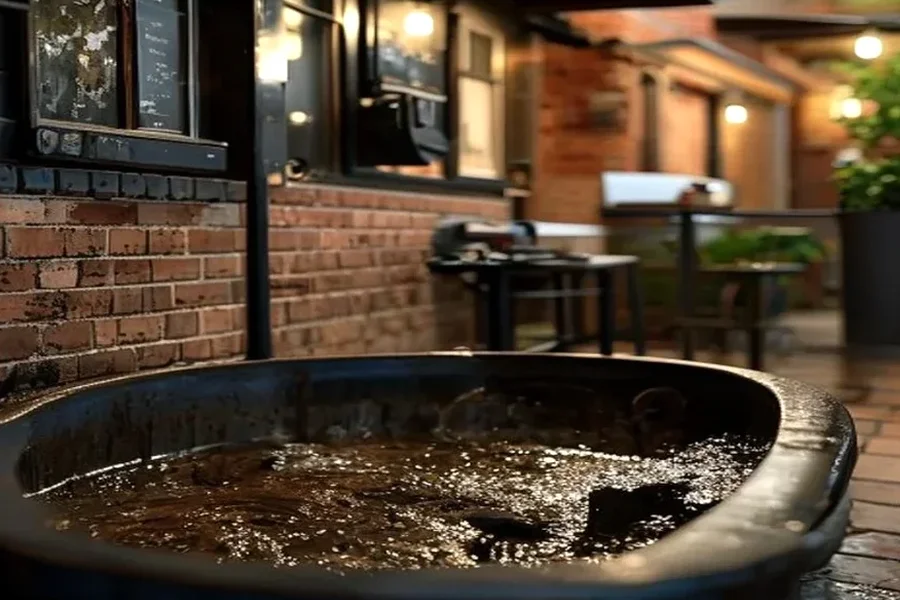
Under-sink grease traps
Small (20-50 gallon) units inside the kitchen. Brick Street Village chef-driven concepts typically run 45-60 day pumping. Eagle Township farmstead restaurants run similar.
- Pump cycle: 45-60 days
- Service time: 30-45 min
Indy Drain Pros — Licensed in Indiana · Bonded & Insured · Satisfaction Guaranteed · (317) 608-3777 Need more context on this neighborhood? See our full Zionsville service area for the full coverage map.
Zionsville's restaurant scene is more chef-driven and upscale per capita than the other Indianapolis suburbs — and it shapes the grease-trap service profile accordingly. Brick Street Village upscale chef-driven dining operates in 1860s-1890s historic commercial buildings along Main Street with long historic FOG discharge runs that need quarterly line jetting. Wolf Run, Bridgewater Club, Holliday Farms, and Royal Run country club dining runs event-driven schedules with member-event interval shortening. Anson commercial restaurants in the newer estate-subdivision commercial cluster run cleaner intervals on properly-sized installations. Eagle Township farmstead-converted restaurants retain original-building plumbing characteristics that mirror Brick Street Village. US-421 / Michigan Road chain dining rounds out the standard 60-90 day chain-restaurant profile. Same Indianapolis flat-rate — no Boone County travel surcharge. Off-hours dispatch standard, Town of Zionsville Wastewater + Boone County Health compliance handled. Part of our full service catalog or our Zionsville service area page. Every Grease Trap Cleaning Zionsville call gets a written quote before we start.
Brick Street Village upscale chef-driven dining. Main Street and the historic commercial corridor through the Brick Street Village host Zionsville's chef-driven restaurant cluster — destination dining concepts in 1860s-1890s historic commercial buildings. The kitchens are smaller-volume than mall-adjacent chains but high-quality, with attention paid to ingredient quality that doesn't necessarily translate to higher FOG generation. The complicating factor is the historic-building plumbing: long FOG discharge runs from trap to city sewer through original lateral routing accumulate emulsified grease that pumping won't reach. Quarterly hydro jetting of the FOG line is the highest-leverage service for these accounts. Village historic-streetscape coordination adds an access-planning layer — we work out access in writing before each visit, respecting the protected village character.
Wolf Run, Bridgewater Club, Holliday Farms, Royal Run country club dining. The four large country-club operations in Zionsville (and the adjacent country-club operations near Carmel and Westfield that serve Zionsville residents) run event-driven service profiles. Tournament weekends, member-event banquets, holiday programs, and the regular member dining patterns create volume surges that intensify the cycle while shoulder weeks run on standard 60-day intervals. We work with country-club facilities management on the off-hours service window that misses the event calendar — typically Monday or Tuesday early-morning windows following Sunday-night banquet operations.
Anson commercial restaurants. The newer estate-subdivision commercial cluster at Anson includes restaurants serving the Anson, Holliday Farms, Wolf Run, and Royal Run residential populations. These are newer-construction installations with properly-sized FOG systems, designed-in service access, and shorter discharge-line runs to the city sewer. Service intervals are 60-day for in-ground interceptors, 45-day for under-sink traps. Multi-location restaurant groups operating in Anson typically run consolidated service contracts.
Eagle Township farmstead-converted restaurants. A handful of restaurants in unincorporated Eagle Township operate in converted farmsteads — restored 1800s-1900s farmhouses now serving as full-service or destination dining. These accounts mirror the Brick Street Village profile in plumbing terms: older building, longer historic FOG discharge runs, quarterly line jetting recommendation. Some also overlap with our septic-to-sewer conversion work where the conversion happens (covered on our Zionsville sewer line repair page) and creates an opening to upgrade the FOG system at the same time.
US-421 / Michigan Road chain restaurants. The chain-restaurant cluster along US-421 / Michigan Road (the corridor connecting Zionsville south toward I-465 and north toward Lebanon) serves standard 60-90 day cycles on properly-sized commercial installations. Less concentrated than the Hamilton Town Center or Greenwood Park Mall clusters, but the standard chain-restaurant compliance profile applies.
From under-sink traps in Brick Street Village chef-driven concepts to in-ground interceptors at Wolf Run banquet operations.
Small (20-50 gallon) units inside the kitchen. Brick Street Village chef-driven concepts typically run 45-60 day pumping. Eagle Township farmstead restaurants run similar.
Outdoor large-capacity (500-2,000 gallon) interceptors at Wolf Run, Bridgewater Club, Holliday Farms country clubs, Anson commercial, and US-421 chains. Baffle scraping included.
Critical for Brick Street Village 1860s-1890s historic buildings and Eagle Township farmstead-converted restaurants where the discharge run is long.
Town of Zionsville Wastewater Utility oversees public sewer compliance; Boone County Health Department handles food-service inspection. The 25% FOG-layer threshold mirrors Marion County's ordinance, but the documentation paths and inspector schedule are different. Brick Street Village historic-district coordination adds a streetscape-access layer for any work that touches public right-of-way.
Service required when FOG layer reaches 25% of total trap volume. We measure every visit and document.
Date, volume pumped, hauler license, disposal facility. Printed copy + digital backup at every visit.
Town of Zionsville Wastewater reporting handled where required — no separate fee. Village historic-district coordination in writing.
When the Boone County Health inspector shows up, you hand them the binder. Every record they need is in one place.
Historic-building backup — same-day dispatch with Village-streetscape access coordination.
Long 1860s-1890s historic FOG runs need quarterly jetting. We restore and set the cadence.
Country-club banquet ahead — pre-event interval shortening keeps the kitchen clean.
Soft-opening trap audit + service contract setup. We baseline before service ramps.
Same flat-rate everywhere — crews staged across the metro. Each area page covers the local pricing detail + access notes.
Brick Street Village + country club + Anson + Eagle Township farmstead coverage. Town of Zionsville Wastewater + Boone County Health compliance. Same Indianapolis flat-rate.
Call (317) 608-3777Town of Zionsville Wastewater + Boone County Health follow the same 25% FOG-layer threshold as Marion County. Brick Street Village upscale chef-driven restaurants typically run 45-60 day cycles with quarterly FOG line jetting due to long historic discharge runs. Country club dining runs 60-day standard with event-week shortening. Anson commercial and US-421 chain restaurants run 60-90 days on newer-construction installations.
The Brick Street Village core — Main Street and the historic commercial corridor — carries 1860s-1890s commercial buildings with long historic FOG discharge runs. Those lines accumulate emulsified grease that pumping won't reach. Quarterly hydro jetting is the highest-leverage service for these accounts. Village historic-streetscape coordination adds an access-planning layer handled in writing before each visit.
Yes. Wolf Run, Bridgewater Club, Holliday Farms, and Royal Run coordinate around tournament weekends, member events, and banquet schedules. We work with country-club facilities management on the off-hours service window that misses the event calendar — typically Monday or Tuesday early-morning windows following Sunday-night banquet operations.
Yes. Town of Zionsville Wastewater oversees public sewer compliance; Boone County Health handles food-service inspection. We provide complete documentation with every service — printed copy plus digital backup — and handle manifest filing where required.
Similar plumbing profile — older building, longer historic FOG discharge runs, quarterly line jetting recommendation. The difference is access and location: farmstead-converted restaurants have larger lots and easier service access than tight Village historic lots. Some farmstead accounts overlap with septic-to-sewer conversion work where the conversion creates an opening to upgrade the FOG system.
Yes. The chef-driven Village restaurant groups and the country-club operations typically run on quarterly service contracts with consolidated billing and unified compliance documentation. Service contracts include the quarterly FOG line jetting for historic-building accounts.
40-55 minutes from our central staging via I-65 north or US-421. Same flat-rate as a Marion County downtown call — no Boone County travel surcharge. Brick Street Village accounts coordinate Village-streetscape access in writing before each visit.
No. Trenchless cut + jet + treatment leaves no surface impact, so emergency root-removal or FOG-line jetting work proceeds without Village-streetscape approvals. Where excavation is involved (rare for grease-trap work), we coordinate with the homeowner / operator and the historic-district administrator in advance.
Quarterly service contracts with FOG line jetting bundled for historic-building accounts. Country-club event-week coordination. Town of Zionsville Wastewater + Boone County Health documentation. Same Indianapolis flat-rate.