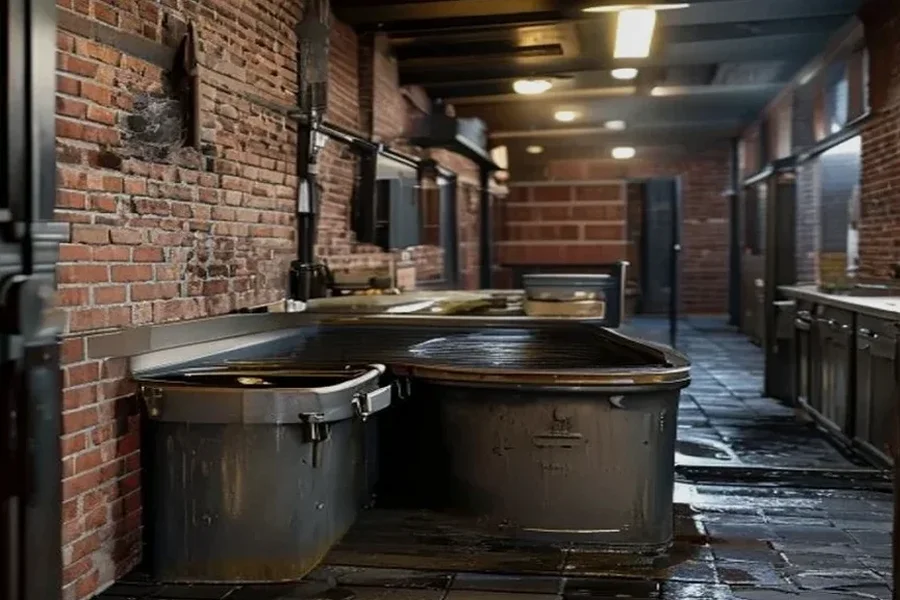
Under-sink grease traps
Small (20-50 gallon) units inside the kitchen. Mass Ave high-volume operations typically run 30-day pumping; moderate volume runs 45-60 days.
- Pump cycle: 30-60 days
- Service time: 30-45 min
Indy Drain Pros — Licensed in Indiana · Bonded & Insured · Satisfaction Guaranteed · (317) 608-3777 Need more context on this neighborhood? See our full Downtown service area for the full coverage map.
Downtown Indianapolis has the densest restaurant concentration in the state — and the most demanding FOG service window in our coverage area. Mass Ave restaurant row runs late-night dining culture that pushes most grease-trap service to early-morning (5-8 AM) windows. Georgia Street and the Cultural Trail dining corridor coordinate around event-night volumes. The Mile Square and Wholesale District steakhouses, conversion-loft restaurants, and ground-floor commercial kitchens need quarterly FOG line jetting in addition to trap pumping because their discharge lines run long historic-building runs to the city sewer. Bottleworks District and the Pan Am Plaza-adjacent dining are newer builds with cleaner system access. We service all of it — scheduled trap pumping, baffle scraping, FOG line jetting, full Marion County compliance documentation, and 15-30 minute emergency dispatch when something backs up mid-service. Part of our full service catalog or our downtown service area page. Grease Trap Cleaning Downtown Indianapolis — same flat-rate at 3 AM Sunday as 10 AM Tuesday.
Mass Ave restaurant row. The state's densest restaurant corridor — full-service restaurants, gastropubs, late-night dining, and a handful of older conversion-building kitchens running ground-level FOG lines through complex historic plumbing. Mass Ave's late-night culture pushes most accounts to early-morning (5-8 AM) service windows because dinner service often extends past 11 PM. Under-sink traps at high-volume operations need 30-day pumping; in-ground interceptors run 60-90 day cycles. FOG line jetting quarterly is the difference between a Mass Ave restaurant that has occasional backups during dinner and one that never does.
Georgia Street and the Cultural Trail dining corridor. Georgia Street's pedestrianized restaurant rows and the Cultural Trail-adjacent dining (Pan Am Plaza, Circle Centre frontage, the connectors to the convention center) coordinate around event-night volumes when conventions, Pacers and Colts games, and concerts at Bankers Life push 3-4x normal volume through the same traps in a single evening. Service intervals shorten during high-event seasons; we adjust the schedule rather than forcing a fixed cadence.
Mile Square and Wholesale District steakhouses + conversion restaurants. The full-service Mile Square steakhouses (the Wholesale District's century-old brick warehouses converted to dining) and the high-end restaurants near the canal have larger in-ground interceptors (1,000-2,000 gallon) and longer historic-building FOG discharge lines than newer construction. The longer discharge lines accumulate emulsified grease that trap pumping won't reach — so quarterly hydro jetting of the FOG line is the standard recommendation, not just trap pumping. Operators that skip the discharge-line work end up with mid-service backups even when the trap is well-maintained.
Bottleworks District. The renovated Coca-Cola plant complex is a newer-build food hall + boutique-hotel operation with modern interceptor placement and cleaner system access than the historic-conversion restaurants. Service intervals tend toward 60-day rather than 30-day because the kitchens were designed with proper trap sizing. Manifest reporting is straightforward because the building management coordinates compliance across the food hall tenants.
Pan Am Plaza and Circle Centre area. Chain restaurants, hotel kitchens (Conrad, JW, Hyatt Regency, Westin), and the convention-center-adjacent food service operations. Hotel kitchens often run institutional-volume FOG generation with larger interceptors on standard 60-90 day cycles. We coordinate with hotel facilities management for after-banquet service windows.
From under-sink traps in Mass Ave coffee shops to 2,000-gallon interceptors at Mile Square steakhouses.
Small (20-50 gallon) units inside the kitchen. Mass Ave high-volume operations typically run 30-day pumping; moderate volume runs 45-60 days.
Outdoor large-capacity (500-2,000 gallon) interceptors at Mile Square steakhouses + Wholesale District conversion restaurants. Baffle scraping included.
Especially critical in historic Mile Square + Wholesale District buildings where the discharge run is long. Quarterly hydro jetting prevents mid-service backups.
Marion County FOG ordinance is straightforward but specific, and Citizens Energy and Indianapolis DPW expect manifest reporting from some operations. The compliance lifecycle is the same across our downtown accounts — we handle it end-to-end so you focus on the dinner service.
Service required when FOG layer reaches 25% of total trap volume. We measure every visit and document.
Date, volume pumped, hauler license, disposal facility. Printed copy + digital backup at every visit.
Indianapolis DPW / Citizens Energy manifest reporting handled for operations that require it — no separate fee.
When the inspector shows up, you hand them the binder. Every record they need is in one place.
Trap full, discharge line clogged, or both. Emergency dispatch — 15-30 min downtown.
Pre-inspection trap service + line jet + documentation cleanup. We'll have you inspection-ready.
Soft-opening trap audit + initial service contract. We baseline your trap and FOG line before service ramps.
Mile Square + Wholesale District historic discharge runs accumulate emulsified grease pumping won't reach.
Same flat-rate everywhere — crews staged across the metro. Each area page covers the local pricing detail + access notes.
Mass Ave + Mile Square + Bottleworks + Cultural Trail dining. Marion County FOG compliance. 5-8 AM off-hours dispatch. 15-30 min emergency response.
Call (317) 608-3777Marion County FOG ordinance requires service when the FOG layer reaches 25% of total trap volume. For Mass Ave restaurant row, Georgia Street dining, and the Mile Square full-service restaurants, that typically lands at 30-60 days for under-sink traps and 60-90 days for in-ground interceptors. Bottleworks and Wholesale District conversion restaurants vary by kitchen volume — we measure on every visit and recommend the right interval after a couple months of service history.
Yes. Off-hours dispatch is the downtown standard — 5-8 AM is our most-requested window for Mass Ave and Georgia Street operators. Late-evening (after 11 PM) works for earlier-closing restaurants, but Mass Ave's late-night culture pushes most accounts to early-morning service. Same flat-rate regardless of window — no overtime charges.
15-30 minutes from our central staging — the fastest dispatch in our entire service area. Mass Ave, Georgia Street, Bottleworks, Wholesale District, and Cultural Trail-adjacent are all within the inner dispatch radius. For a dinner-service emergency we prioritize routing so we arrive while the restaurant can still recover the service window.
Yes. Marion County requires logs showing date, volume pumped, hauler license, and disposal facility — and some operations require manifest filing with Citizens Energy / Indianapolis DPW. We provide printed documentation at every service, digital backup, and handle the manifest filing where required.
The Mile Square and Wholesale District conversion buildings often have long historic-building FOG discharge runs from the trap to the city sewer. Those runs accumulate emulsified grease and biofilm that trap pumping doesn't reach. Quarterly hydro jetting is the difference between occasional mid-service backups and a clean year.
Yes. We adjust service intervals around the Georgia Street + Pan Am Plaza event-night surge (Pacers, Colts, conventions, concerts). When a restaurant's normal 60-day cycle gets compressed by event volume, we shorten the interval rather than forcing a fixed cadence.
Yes. Multi-location restaurant groups across Mass Ave, the Mile Square, and the Bottleworks food hall typically run on quarterly or monthly service contracts with consolidated billing and unified compliance documentation across locations. We coordinate with chef-owners, GMs, or facilities management depending on the operator's preference.
Bottleworks coordinates compliance across the food-hall tenants through building management — we service the shared FOG system on a single contract and the tenants receive consolidated documentation. Same approach works for Circle Centre dining and the convention-center-adjacent food courts.
Quarterly service contracts. Off-hours dispatch (5-8 AM). Marion County FOG documentation handled. 15-30 minute emergency response. Mass Ave through Mile Square through Bottleworks.