This story is why we camera-scope every sewer call now, even when the customer or a prior contractor has already diagnosed the problem. Visual evidence prevents expensive mistakes.
Sewer Camera Inspection Case Study: The setup
A homeowner in Irvington — let's call her Megan — called us in spring 2024. Her 1923 brick home had been showing classic sewer-restriction signs for six months: slow drains across multiple fixtures, occasional gurgling toilets, eventually water at the basement floor drain during a heavy rain.
She'd had two prior plumbing companies out. Both said roughly the same thing:
Megan was about to write the check when a neighbor recommended camera-scoping first. She called us for a second opinion.
The diagnostic
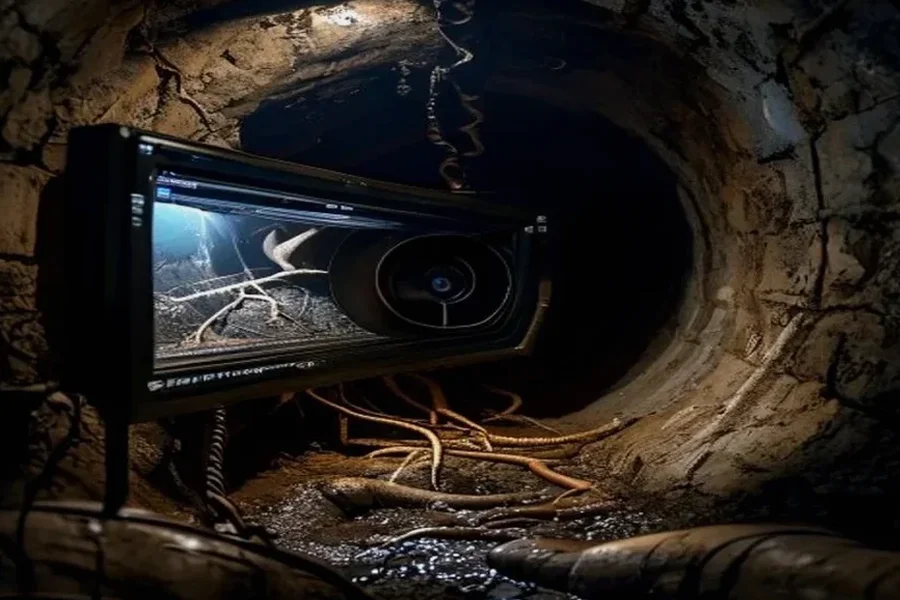
Our standard sewer camera inspection: $250 flat-rate, 30-45 minutes, HD video with locator marking. We arrived, accessed her exterior cleanout, and fed the camera down the lateral.
Findings:
- First 40 feet: clean clay tile. Joints intact. No visible damage. Some surface scale but structurally sound.
- Foot 42-43: Massive root mass — a single tap-root from the maple at the curb had found one joint and grown a 6-inch root ball inside the pipe.
- Past the root mass: Pipe continued clean to the city tap. No further issues.
The diagnosis from the prior contractors was wrong. The pipe wasn't "at the end of its life." It was a 100-year-old clay tile lateral in perfectly serviceable condition with a single root intrusion problem.
The fix
Standard root removal protocol:
- Mechanical cutting with a cable + cutting head sized to the pipe. Cut the root mass back to the pipe wall. (~45 minutes)
- Hydro jet flush at 4,000 PSI. Flushed the cut root material downstream. Cleaned the pipe wall where roots had been attached. (~30 minutes)
- Foaming herbicide treatment. Applied RootX-equivalent foaming agent through the line. Kills root tips on contact, prevents same-season regrowth. (~20 minutes)
- Post-treatment camera scope to confirm cleared line. (~15 minutes)
Total cost: $400 (the upper end of our root-removal flat-rate for moderate intrusion + foaming treatment).
The economics
Megan's choices:
- Original plan: $8,400 trenchless pipe bursting + new pipe
- What we did: $400 root removal + foaming herbicide
- Savings: $8,000
- Long-term plan: Annual maintenance ($400-$500/year) keeps the line clear indefinitely
Even projecting 20 years of annual maintenance at $500/year ($10,000), it's only marginally more than the one-time pipe bursting cost. AND she keeps the original 1923 clay tile lateral, which is still structurally sound. AND she avoids the disruption of a full pipe replacement.
Why we now camera-scope every sewer call
Before this kind of case taught us the lesson, we sometimes accepted prior diagnoses at face value, particularly when they came from established plumbing companies. We don't anymore.
What we learned:
- Visual evidence is the only reliable diagnostic. Symptoms can suggest many causes; the camera shows the actual cause.
- Some contractors recommend the most expensive option by default. Not malicious — often a function of training to "fix it permanently" rather than match the solution to the actual problem.
- Older Indianapolis pipe is more durable than reputation suggests. Clay tile from 1900-1930 is still serviceable in most cases. Cast iron from the same era is similarly long-lived if not chemically damaged.
- $250 camera scope can save $5,000-$10,000 in unnecessary repair. Best-leverage spend in residential plumbing.
When camera scope is mandatory
For any sewer issue beyond a single emergency clearing, we now require camera scope before quoting major repair work. Specifically:
- Any home where prior contractors quoted $3,000+ for sewer work
- Pre-purchase inspections (we won't quote repair on a home we haven't scoped)
- Recurring backups (camera identifies the actual cause)
- Any major sewer repair quote — trenchless lining, pipe bursting, or excavation
Megan still calls us for her annual maintenance. The 2024 root mass hasn't returned. Her clay tile lateral is now 102 years old and still doing its job.
The takeaway
If you've been quoted $5,000+ for sewer repair without a camera inspection showing the damage, get a second opinion with a camera scope first. $250 spent on diagnostic could save thousands on unnecessary repair.
For our camera inspection service details and pricing.