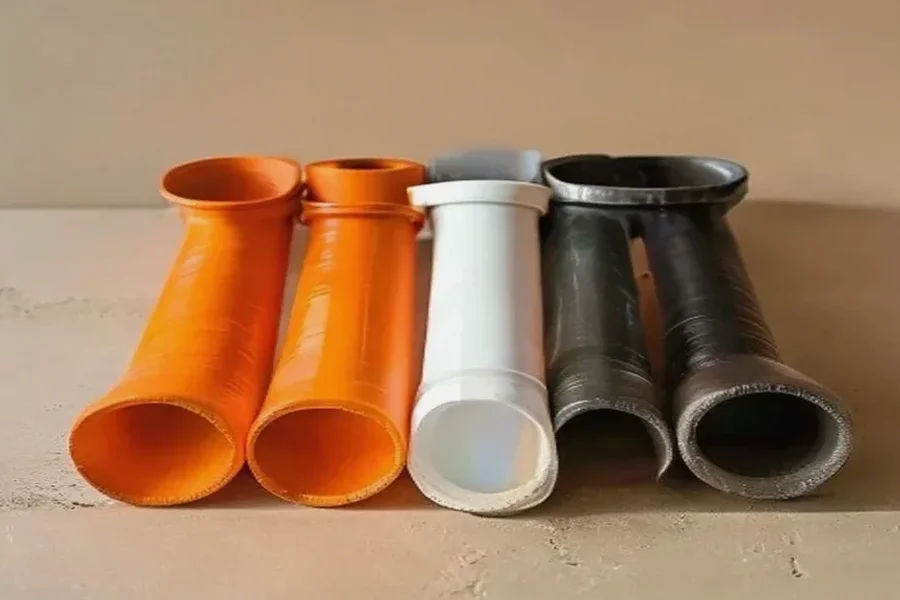
Pipe materials matter because they determine what's likely to fail, what kind of cleaning is safe, and what kind of repair is necessary when something does fail. A Drano-fueled clog clearing strategy that's fine for a 1995 Carmel house is destructive in a 1920 Fountain Square home. Here's what's in the ground beneath Indianapolis houses.
Pipe Materials Indianapolis Homes: Cast iron — the workhorse of pre-1980 Indianapolis
If your Indianapolis home was built between roughly 1900 and 1980, your interior drains are almost certainly cast iron. Look at the trap under any sink: if it's heavy gray-black metal that rings when tapped with metal, that's cast iron.
What it handles
- Extreme temperature swings (boiling water, cold water — no issue)
- Standard mechanical cabling (snakes don't damage healthy cast iron)
- Hydro jetting at 4,000 PSI (gold standard for scale removal)
- 50-100 year service life if maintained
What damages it
- Chemical drain cleaners — sodium hydroxide accelerates internal corrosion
- Mineral scale — Indianapolis water hardness deposits scale that narrows the inside diameter over decades
- Hydrogen sulfide gas — from accumulated organic material; eats the top of horizontal pipes
- Time — eventually all cast iron pits through, particularly at threaded fittings
Failure modes
Pinhole leaks (slow, often behind walls), section collapse (sudden), partial pipe wall failure on horizontal runs (visible water staining).
Vitrified clay tile — Indianapolis's sewer lateral material
Most Indianapolis homes built before 1980 have clay tile sewer laterals — the buried pipe from your foundation out to the city main. Clay tile arrived in 2-3 foot lengths and was mortared together at the joints.
What it handles
- 100+ years of buried service in stable soil
- Mechanical cleaning, including root cutters
- Hydro jetting (if structurally sound)
- Chemical resistance — clay tile itself is essentially inert
What damages it
- Soil shifting — Indianapolis clay soil expands and contracts with moisture; over decades, joints separate
- Tree roots — once a joint opens even slightly, roots find it and grow inside
- Heavy equipment over the lateral — driveway resurfacing, large tree removal
- Original mortar deterioration — lime-based mortar weathers over a century
Failure modes
Joint separation (most common — visible on camera as a gap), partial collapse, full collapse, root mass blockage. Cracks rarely fail clay tile itself; the joints between sections fail.
Galvanized steel — the brief experiment
Some Indianapolis homes built 1920-1950 have galvanized steel for portions of the drain system, particularly above-ground sections in walls and crawl spaces. Recognizable as silvery metal pipe with threaded fittings.
What it handles
- Reasonable longevity (50-70 years)
- Standard cleaning
What damages it
- Internal rust at threaded joints — almost all galvanized failures happen at thread points
- Mineral scale builds up faster than cast iron (rougher interior surface)
- Chemicals (same as cast iron)
Most galvanized steel drain pipe in Indianapolis homes has been replaced by now. If you have it, plan for eventual full replacement — sections fail unpredictably.
PVC — the modern standard
Indianapolis homes built after 1980, plus many older homes that have been renovated, use PVC (polyvinyl chloride) for drain lines. White, smooth, lightweight, joined with glued slip fittings.
What it handles
- 50+ year service life when properly installed
- Standard cleaning — cabling and jetting both safe
- Chemical resistance (better than cast iron, not perfect)
- Soil shifting tolerance (more flex than clay tile)
What damages it
- UV exposure — sunlight degrades PVC; pipes above-grade outdoors need painting
- Builder-grade installation — improper slope, undersized lines, glue joints poorly assembled
- Extreme heat — boiling water repeatedly degrades old PVC; PVC near steam pipes can warp
- Heavy equipment impacts — buried PVC laterals can crack under driveway weight
Failure modes
Glue joint failures (the slip joints under sinks separate), pipe sagging (creating "bellies" where water pools), section breaks from impact, occasional UV-driven brittleness in exposed sections.
ABS — PVC's twin
ABS (acrylonitrile butadiene styrene) is the black version of PVC. Functionally similar — same handling characteristics, same failure modes, slightly more impact-resistant. Used interchangeably with PVC in some Indianapolis builds.
Copper — interior supply, occasionally drains
Copper is primarily a water supply pipe material, but some 1950s-1970s Indianapolis homes used copper for drain piping in unusual situations (basement floor drains, certain bathroom configurations). If you see green-tinted copper drain pipe, it's older and may need replacement.
What's most commonly in Indianapolis homes
Quick reference by housing era:
- Pre-1920: Cast iron drains, clay tile lateral, possible galvanized branches
- 1920-1950: Cast iron drains, clay tile lateral, mixed galvanized
- 1950-1980: Cast iron drains, clay tile or early PVC lateral
- 1980-2000: PVC throughout, some cast iron in transitional builds
- 2000+: PVC throughout, no clay anywhere
How to tell what you actually have
The cheapest, fastest, most accurate way: camera scope inspection. The footage shows pipe material clearly — clay tile has joint patterns every 2-3 feet, cast iron has uniform texture with scale, PVC is bright white and smooth. $200-$350 flat-rate, takes 30-45 minutes.
Alternative: inspect visible plumbing. Look at the P-trap under your sinks, the vent stack on your roof, the cleanout cap on the yard or basement floor. The material on visible portions usually matches what's buried.
Why this matters for service decisions
- Cast iron homes benefit from periodic hydro jetting to remove scale; chemical cleaners damage the metal
- Clay tile laterals need annual root maintenance OR one-time trenchless lining; full excavation is rarely the right answer
- PVC homes need standard cabling for most clogs; joint inspection if leaks appear
- Mixed material homes need camera scoping before any major work to confirm where transitions happen
For more reading, see how to unclog drains without damaging your pipes and why chemical cleaners damage every pipe material.