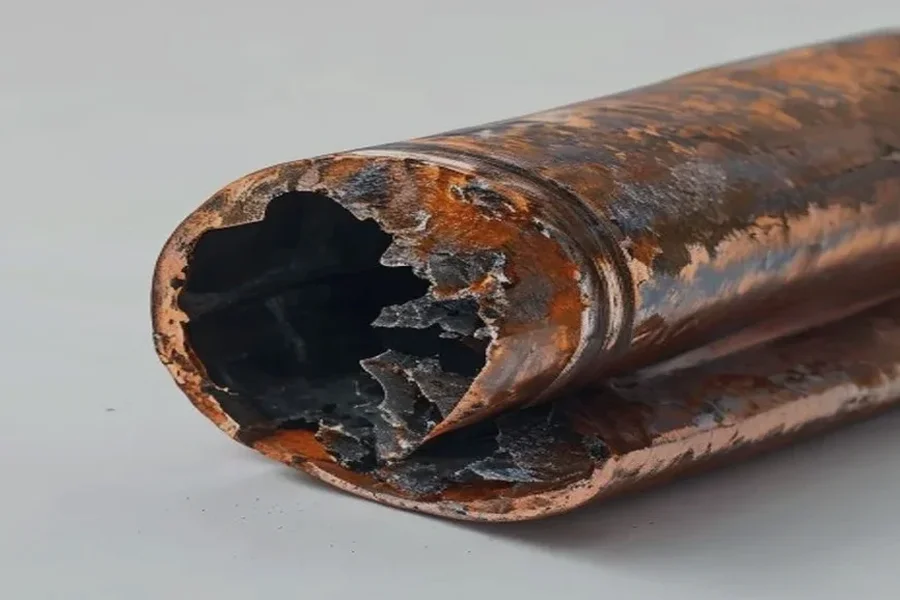
Every Indianapolis drain service call has roughly the same first 30 seconds: the homeowner says "I tried Drano first." Almost without exception. And almost without exception, the Drano didn't help — it either made the clog worse, sat in the trap creating a hazard, or damaged the pipe in ways the homeowner won't notice for years.
Here's the technical reason why chemical drain cleaners are a bad first move, with specifics about why they're particularly destructive in Indianapolis's older housing stock.
Chemical Drain Cleaners Damage Pipes: The chemistry — what's actually in the bottle
Most consumer drain cleaners contain one of three active ingredient categories:
- Sodium hydroxide (lye) — found in Drano Max Gel, Liquid-Plumr. Strong alkali that saponifies grease (turns it into soap) and dissolves hair via protein hydrolysis.
- Sulfuric acid — in some "professional" products. Extremely caustic; dissolves organic matter through oxidation.
- Sodium hypochlorite (bleach) + sodium hydroxide — in some thicker gel formulations. Combined oxidation and alkaline attack.
All three categories work by chemically breaking down the clog. The problem is that they don't selectively attack the clog — they attack everything they touch.
What they do to cast iron (common in pre-1985 Indianapolis homes)
Cast iron drains have a thin oxidized layer on the inside that protects the underlying metal. Lye attacks this layer. Repeated exposure thins the metal at points of pooled chemical (typically the bottom of the pipe and the bottom of fittings). Over years, you get rust-through pinholes — first as slow leaks behind walls, eventually as full sections that need replacement.
This is especially common in Indianapolis homes built between 1900 and 1980, where cast iron was the standard drain material. Camera scopes of Drano-frequent homes routinely show pitting and accelerated scaling.
What they do to PVC
Modern PVC is more chemical-resistant than cast iron, but it's not invincible. Sulfuric acid attacks PVC over time. Lye softens PVC glues used at joints — particularly the slip joints under sinks. Repeated exposure causes joint failures: pinhole leaks at the glue line, complete joint separation in severe cases.
Newer Indianapolis subdivisions (1990s+) have PVC throughout. Drano + 20 years = compromised joints.
What they do to clay tile (sewer laterals)
Most consumer drain cleaners don't reach the sewer lateral — they react with whatever's in the trap and stay there. But hot weather can cause vapor migration. Clay tile is essentially inert chemically, but the mortar between joints isn't. Lye dissolves mortar slowly. Joint failures follow.
The bigger problem: chemicals don't clear real clogs
A drain that's blocked enough to back up usually has the chemical sitting on top of standing water, with the actual clog below. The chemical can't reach the clog directly — it slowly dissolves the upper layers of debris, but can't break through major obstructions.
Meanwhile, the chemical is concentrated in the trap, sitting on metal or glue joints, doing damage.
What works instead
- Boiling water — melts grease without damage (kitchen sinks)
- Baking soda + vinegar — mild alkaline, safe for all pipe materials
- Bio-enzyme drain treatments — eat organic matter without affecting pipe (Bio-Clean, Pure Lakes brands)
- Plunger + hand auger — mechanical removal beats chemical attack
- Professional cabling — when DIY isn't enough, mechanical cleaning is the right escalation, not chemical
For the full DIY playbook, see How to Unclog a Drain Without Chemicals.
The exception — and it's narrow
Enzyme-based drain maintenance products (Bio-Clean, Pure Drain, RID-X) use bacterial enzymes to break down organic matter. They're slow (work over hours or days) but safe for all pipe materials and useful as monthly preventive maintenance. These are not "drain cleaners" in the Drano sense — they're maintenance products.
What to do if you've already used chemicals
If you've used a chemical drain cleaner and the line is still blocked:
- Stop adding more chemical. More doesn't help; it accumulates.
- Wait 4-6 hours minimum before calling a plumber (or before trying mechanical removal yourself). Lets the chemical sit and react with whatever it's going to react with.
- Tell the plumber. They'll wear protective equipment.
- Consider a camera scope after clearing. If the line shows pitting or joint damage, plan ahead for eventual repair.
For professional drain clearing without chemical exposure, see our drain cleaning service page. We work with whatever you've put down the line — but we'd rather you skip the chemistry.